
A PPC manager I know signed a six-figure Adthena contract last year, then discovered three months in that half her team's use case, brand protection against affiliate bidding, wasn't even the tool's strongest feature. She'd bought enterprise search intelligence when what she actually needed was dedicated brand monitoring.
That mismatch is the exact problem this guide solves. Not just which tool costs less, but which one actually matches what you're trying to accomplish.
What Is Adthena?
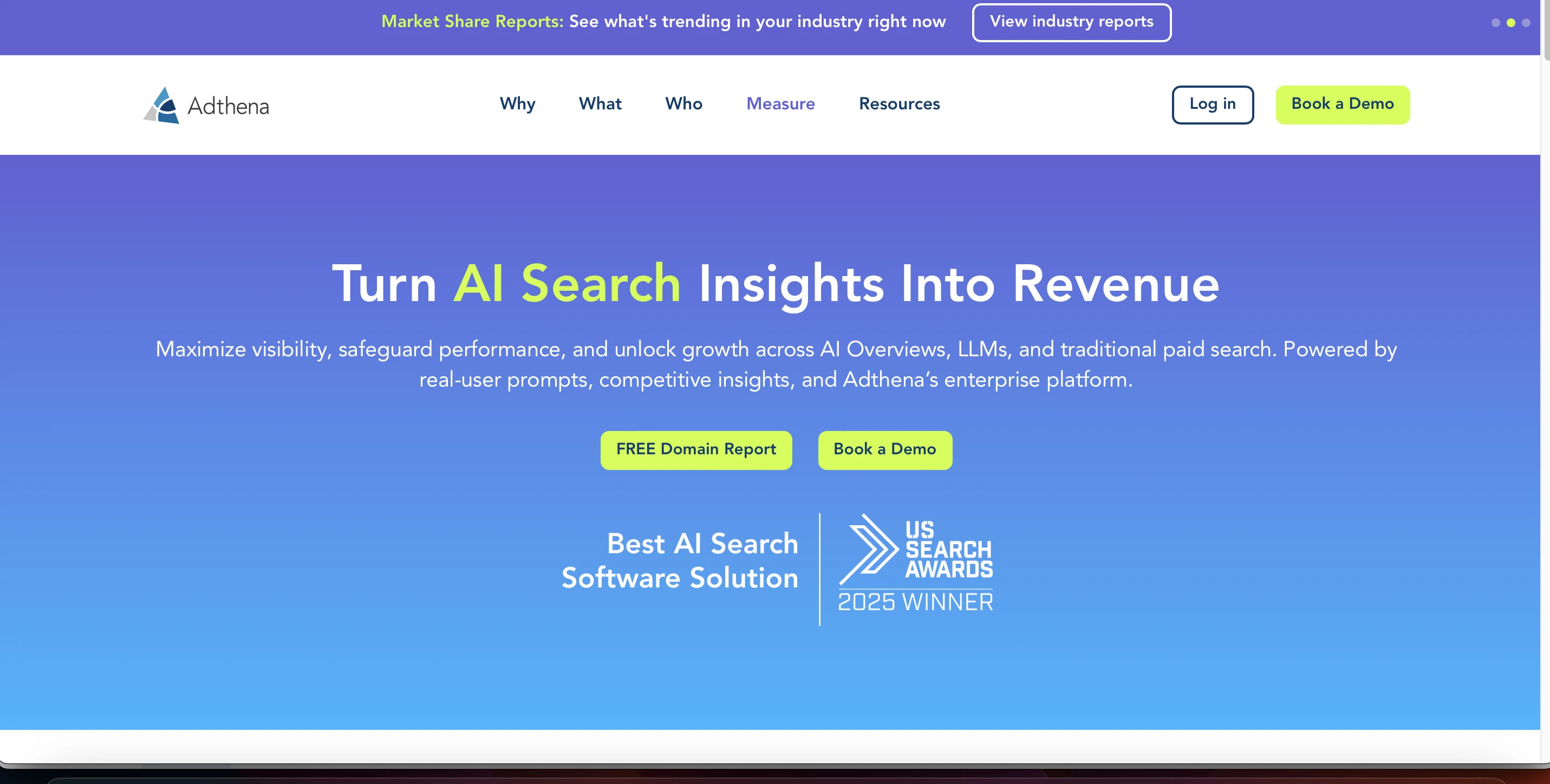
Adthena is a powerful, enterprise-grade search intelligence tool for PPC that gives you deep insight into competitors, market share, keyword strategy, ad copy, and brand protection. It uses AI and a patented Whole Market View to help large companies and agencies make smarter, more efficient decisions in their paid search efforts.
But it's not always the ideal choice, especially for smaller companies, teams with limited budgets, or marketers who want different kinds of insights. That's why many are looking for Adthena alternatives.
 Quick Comparison Table of Adthena Alternatives
Tool | Main Feature | Ideal For | Starting Price |
|---|---|---|---|
SEMrush | PPC + SEO + competitor ad research | Marketers needing an all-in-one search intelligence tool | $99/month |
Similarweb | Market-level traffic & competitive intelligence | Teams wanting broad digital market insights and channel mix | $199/month |
Google Ads Auction Insights | Real-time auction overlap & impression share | Advertisers who want real competitors in their Google auctions | Free |
iSpionage | PPC competitor intelligence + landing page monitoring | PPC managers and SMBs tracking competitor campaigns | $59/month |
Adbeat | Display & programmatic ad intelligence | Brands running or analyzing display and native campaigns | $249/month |
The Search Monitor | Brand bidding & trademark abuse monitoring | Enterprises and agencies focused on brand protection | Custom pricing |
The Data Methodology Gap Nobody Explains Clearly
Here's the value most comparison articles skip entirely, and it's the single most important factor in whether any tool on this list gives you numbers you can actually trust.
Every one of these platforms collects competitive data differently, and that methodology directly determines accuracy for your specific site. Adthena leans on its proprietary Whole Market View AI modeling. Similarweb blends real user panel data with clickstream sources. iSpionage and Adbeat largely rely on scraped and crawled ad placements. Google Ads Auction Insights is the only one pulling from actual, first-party auction data, because it's built directly into the platform running the auctions.
Why This Matters More Than the Feature List
Panel and clickstream-based tools like Similarweb perform strongly for high-traffic competitors where the sample size is large enough to be statistically meaningful. For niche or lower-volume competitors, that same methodology can produce estimates that are directionally useful but numerically unreliable, sometimes off by a wide margin.
Scraped and crawled data, the approach behind iSpionage and Adbeat, captures what ads actually ran and when, but can miss geo-targeted or dayparted campaigns the crawler simply never encountered. Google's Auction Insights avoids all of this uncertainty because it only reports on auctions you were actually in, but that also means it's blind to any competitor activity outside your own campaigns entirely.
The practical takeaway: if your competitive set includes smaller or regional advertisers, weight tools using real auction or crawled data more heavily than pure panel-based estimates. If you're tracking large national brands, panel data from Similarweb or SEMrush becomes far more reliable because the sample size supports it. Matching methodology to your actual competitive landscape matters more than any single feature comparison, and it's the step every other Adthena alternatives article skips.
Why Consider an Adthena Alternative
Businesses look for alternatives for several consistent reasons.
Cost concerns play a significant role. Adthena is designed primarily for enterprise-level users, and its pricing reflects that, which means smaller teams may find the investment hard to justify relative to the return.
Specific needs misalignment is common too. While some marketers require deep historical keyword data, others prioritize display or mobile ad insights, or simply need basic competitive visibility, making certain alternatives a genuinely better fit than a full enterprise suite.
Brand protection limitations push some brands elsewhere. Although Adthena includes brand-protection features, some competitors specialize specifically in monitoring ad copy or auction overlap, which can better suit focused strategies.
Data variety rounds out the list. Different tools collect and present data in varying ways, some rely on sampled data, others on clickstream or scraped data, and depending on whether accuracy, scale, or a specific insight type matters most, other tools may serve you better.
Top 6 Adthena Alternatives
Here are the leading alternatives, each with a specific strength, honest limitation, and a clear read on who should skip it entirely.
1. SEMrush
SEMrush is an all-in-one platform for SEO and PPC, eliminating the need for separate tools. It provides rich competitor data, including display and video insights through AdClarity, and offers easy-to-export, shareable reports to help teams act quickly.
Key features include competitor ad research showing which keywords domains bid on and their ad copy history, PLA research for Google Shopping campaigns, a PPC Keyword Tool for building keyword groups, an AI-driven Ads Launch Assistant, AdClarity on the Pro plan for display and video ad insight, and historical advertising data for trend analysis.
Pricing
The Advertising Toolkit Base runs $99 monthly for core ad research tools. The Pro tier costs $220 monthly and unlocks AdClarity along with deeper historical and display data.
Pros | Cons |
|---|---|
Very broad and integrated toolset | High cost, especially for smaller businesses |
Massive keyword and backlink database | Steep learning curve with many tools and metrics |
Strong competitor research across PPC and organic | Data is estimate-based, not always fully accurate |
Custom and flexible reporting dashboards | Some features locked behind costly add-ons |
Regular updates and strong support resources | Adding extra user seats is expensive |
Who should NOT use SEMrush: Teams needing dedicated brand protection or trademark enforcement. SEMrush's competitive intelligence is broad but shallow specifically in that category compared to The Search Monitor.
2. Similarweb
Similarweb provides PPC insights backed by real user behavior, giving a more accurate view of search activity than simple bid-level estimates. It's ideal for market-level and competitive strategy, offering a broader perspective beyond just individual keywords.
Key features include Paid Keyword Insights revealing competitor CPC and high-opportunity terms, Search Ads Analysis for ad copy and landing pages, a Paid Search Overview estimating spend and share, a SERP Players Report showing which domains dominate paid auctions, and device and geographic segmentation through Search 3.0.
Pricing
The Web Intelligence Starter plan begins at $199 monthly for basic competitive benchmarking and paid-search data. Larger plans scale to custom enterprise pricing.
Pros | Cons |
|---|---|
Broad market intelligence and real-user behavior data | Pricing can be very high for deep features |
Intuitive interface, easy to navigate | Accuracy concerns for smaller or niche sites |
Strong competitor analysis and cross-region insights | Limited data granularity on lower tiers |
Device and geography segmentation for paid trends | Sparse historical data unless on a high plan |
Who should NOT use Similarweb: Teams competing against smaller regional advertisers where panel sample sizes are too thin to be reliable, exactly the methodology gap covered above. If you want a deeper breakdown of exactly where Similarweb fits against its direct competitors, our full Similarweb alternatives comparison covers that decision in detail.
3. Google Ads Auction Insights
Google's built-in Auction Insights report is not a separate paid tool, it's part of the Google Ads UI, providing direct visibility into who else is competing with your campaigns within the same ad auctions.
Key features include Impression Share showing what percentage of eligible impressions you and competitors capture, Overlap Rate tracking how often a competitor's ad appears alongside yours, Outranking Share measuring how often you beat a competitor's position, Top of Page and Absolute Top Rate metrics, and segmented views at the campaign, ad group, or keyword level.
Pricing
Free, included natively within Google Ads at no additional subscription cost.
Pros | Cons |
|---|---|
Real Google Ads auction data, highly accurate | Only shows competitors in the same auctions |
Free with no additional subscription cost | Doesn't reveal ad copy or landing pages |
Integrated directly into Google Ads | Requires enough campaign volume for meaningful data |
Easy to segment by campaign, group, or keyword | No advanced export or long-term historical tracking |
Who should NOT use Google Ads Auction Insights: Anyone needing visibility into competitor activity outside their own auctions, display advertising insight, or ad copy archives. It's the most accurate tool here and also the narrowest in scope by design.
4. iSpionage
iSpionage is specifically focused on paid search, making it highly efficient for competitive PPC research. It provides historical depth, allowing you to review months or years of competitor ad campaigns to uncover long-term strategies.
Key features include Competitor Keyword Research showing bidding and performance, an Ad Copy Archive tracking headline and description changes, Landing Page Monitoring for competitor A/B experiments, Alerts and Monitoring for new campaign activity, and SEO Rank Tracking alongside PPC data.
Pricing
Starter runs $59 monthly with 3 months of historical data and 15 PPC-monitor keywords. Professional costs $99 monthly, or $84 on annual billing, with 12 months of history. Advanced reaches $299 monthly with 24-month history and unlimited exports. Enterprise is custom-priced for large agencies.
Pros | Cons |
|---|---|
Clean and user-friendly interface | Historical estimates may not perfectly match real spend |
Good competitor PPC and SEO insight combined | Limited database size versus large all-in-one platforms |
Alerts for competitor campaign and keyword changes | Deep historical data reserved for higher plans |
More affordable than many enterprise tools | Lacks display or programmatic advertising data |
Who should NOT use iSpionage: Brands running significant display or programmatic campaigns. It's purpose-built for search and has essentially no visibility into that ad format at all.
5. Adbeat
Adbeat specializes in programmatic and display advertising, making it a powerful tool for researching creative strategies and publisher placements, helping you identify new publisher opportunities or avoid oversaturated channels.
Key features include Display Network Coverage across many programmatic channels, Publisher Insights showing which sites competitors use, a Creative Library archiving historical ad formats, Country and Device Filters for geographic segmentation, and Alerts and Exports in CSV or PDF format.
Pricing
Standard runs $249 monthly with 90 days of historical data. Advanced reaches $399 monthly with a full year of data and country-level filters. Enterprise is custom, including estimated ad spend and campaign-level detail.
Pros | Cons |
|---|---|
Very strong for display and programmatic intelligence | Expensive standard plan for the value it offers |
Deep publisher insights on placement strategy | Best features locked behind expensive tiers |
Historical creative library shows ad evolution | Interface feels dated compared to modern tools |
Covers many ad networks, not just one channel | Limited onboarding materials for new users |
Who should NOT use Adbeat: Anyone whose primary focus is search keyword bidding. Adbeat has essentially no search keyword tracking, it's a display-only specialist by design.
6. The Search Monitor
The Search Monitor is a strong choice for brands that need dedicated protection of their trademarks, reputation, and ad space, especially against third-party affiliates or unauthorized bidders. It offers enterprise-level monitoring well-suited for large brands and teams managing extensive affiliate programs.
Key features include Global Ad Monitoring across regions and languages, Brand Bidding Alerts when someone bids on your trademark, Affiliate Compliance monitoring, Creative Tracking archiving ad changes over time, and detailed Export and Reporting in CSV or PDF.
Pricing
Pricing is custom and generally quoted per enterprise, depending on markets, keywords, and seats. Large enterprises commonly negotiate per-account pricing given the scale involved.
Pros | Cons |
|---|---|
Excellent for brand protection and trademark tracking | Pricing is often high, less accessible for small businesses |
Global coverage by region, country, and device | Learning curve for crawls, alerts, and interpretation |
Automated enforcement can submit ad takedowns | Advanced features reserved for higher enterprise tiers |
Custom alerting and detailed share-of-voice reporting | Interface can feel complex for first-time users |
Who should NOT use The Search Monitor: Smaller teams without a dedicated legal or brand-protection function. This is purpose-built enforcement tooling, not general competitive research, and the pricing reflects that specialization.
Adthena vs Top Adthena Alternatives
Here's the full side-by-side comparison to see which tool suits your specific need.
Feature / Tool | Adthena | SEMrush | Similarweb | Google Auction Insights | iSpionage | Adbeat |
|---|---|---|---|---|---|---|
Primary use case | AI-driven search intelligence | SEO + PPC research | Market & traffic intelligence | Auction visibility | PPC competitor monitoring | Display & programmatic intel |
Paid search monitoring | Comprehensive | Integrated | Trend-level | Native Google data | Focused | Mainly display |
Display/programmatic insights | Limited | Partial via AdClarity | Strong | Not available | Minimal | Core feature |
Competitor keyword intelligence | Very strong | Strong | Market-level | Overlap metrics only | Focused & deep | Not keyword-focused |
Brand protection monitoring | Basic to mid-level | Limited | Limited | Not included | Partial | Not a brand safety tool |
Historical data depth | Multi-year | Multi-year | Extensive behavior history | Limited | Long-term PPC history | Up to 12+ months |
Real-time data | Near real-time | Regular refresh | Daily updates | Real-time from auction | Scheduled | Regular refresh |
Geo coverage | Global | Global | Global | Campaign-limited | Good global coverage | Global, publisher-dependent |
Ease of use | Medium | Easy to moderate | Moderate | Very easy | Easy | Easy to moderate |
API availability | Yes | Yes | Yes | No | Yes | Yes |
Cost suitability | High-budget teams | All business sizes | Mid-size to enterprise | Free | Small to mid-size PPC | Mid-size to large advertisers |
How to Choose the Right Adthena Alternative
Picking the best fit depends on your business size, budget, and actual goals.
Budget should shape your shortlist immediately. Enterprise tools cost significantly more, and smaller businesses may prefer SEMrush or iSpionage over the pricier options.
Data needs matter next. Select tools based on your actual focus, paid search, display ads, or broader market trends, rather than chasing the most feature-rich option available.
Brand protection deserves special attention. Adthena offers active protection, while several alternatives only provide visibility without enforcement capability.
Historical versus real-time data should match your workflow. Pick tools built for long-term trend analysis or real-time auction metrics depending on which actually drives your decisions.
Ease of use and integration rounds it out. Consider UI simplicity, existing tool integrations, and alerting capabilities for competitor activity before committing.
Common Challenges With Adthena Alternatives
Adthena alternatives can be genuinely useful, but many share similar limitations worth knowing upfront.
Data accuracy is the recurring issue, since tools rely on different methods like sampled data or clickstream panels, which can lead to inconsistent insights depending on your specific competitive landscape.
Limited visibility shows up frequently too, with some platforms focusing only on certain ad types or providing shallow competitive data outside their specialty.
Brand-protection features can be weaker than expected across several alternatives, making it harder to track trademark misuse or affiliate violations at scale.
Learning curves affect several tools, especially those with large datasets or complex dashboards that take real time to master. And while many alternatives cost less than Adthena upfront, advanced features or higher data limits can still become expensive for smaller teams as usage scales.
How to Use an Adthena Alternative: A Practical Playbook
Here's how to turn raw competitive intelligence into actual decisions.
Run a weekly competitor scan. Pull the top 20 competitor ads for priority keywords and save the changes in a shared tracking sheet.
Mine creative testing inspiration. Identify the language and offers competitors use, then build A/B tests to counter or improve on that messaging.
Set brand protection alerts. Establish automated watches on trademarked terms and get notified when unauthorized ads appear.
Conduct a quarterly strategy review. Use share-of-voice trends to justify budget shifts or new keyword targets to leadership.
These steps turn the tool from a reporting dashboard into an actual decision aid, which is the entire point of paying for competitive intelligence in the first place.
Conclusion
Adthena is a strong paid search intelligence tool, but it isn't the best fit for every budget or business need. SEMrush works well for combined SEO and PPC strategy, Similarweb is ideal for market-level trends, Adbeat excels in display analysis, iSpionage is efficient for campaign-level PPC tracking, Google Ads Auction Insights provides free real-time auction data, and The Search Monitor remains the strongest choice specifically for brand protection.
The real decision isn't which tool has the most features. It's matching the platform's data methodology and specialty to your actual competitive landscape, small regional competitors need different tooling than national brand rivals, and getting that match wrong is the single most common mistake teams make when switching away from Adthena.
FAQs
What are Adthena alternatives?
They're competitive intelligence and PPC monitoring tools offering similar features like keyword analysis, competitor tracking, and brand protection at varying price points.
Why should I consider an Adthena alternative?
Cost, feature mismatch, or needing deeper display or brand-protection data than Adthena's general suite provides are the most common reasons teams switch.
Which Adthena alternative is best for combined SEO and PPC research?
SEMrush is widely considered the strongest choice, offering competitive keyword data, ad copy history, and SERP tracking in one platform.
What is the best free Adthena alternative?
Google Ads Auction Insights, since it provides real auction data directly from Google Ads at no additional cost.
Are Adthena alternatives budget-friendly for small businesses?
Yes, tools like iSpionage and SEMrush's base tier offer lower-cost plans that work well for smaller teams without enterprise budgets.