
AI agents are no longer experimental tools for early adopters. In 2026, they are becoming operational coworkers capable of planning tasks, using external tools, automating workflows, and even collaborating with other agents.
This shift is visible even in free-tier tools aimed at individuals and small teams Dacmef Free, for example, pairs basic task management with AI-powered video creation, letting users test AI-driven workflows without any upfront cost. Enterprises are deploying them across customer support, software engineering, research, sales operations, and internal automation.
Unlike traditional chatbots, modern AI agents can maintain memory, execute multi-step tasks, interact with APIs, and make decisions with minimal human supervision. The competition is now shifting from "who has the smartest model" to "who has the most reliable autonomous system."
Here are the 10 AI agents making the biggest impact in 2026.
Appwizzy
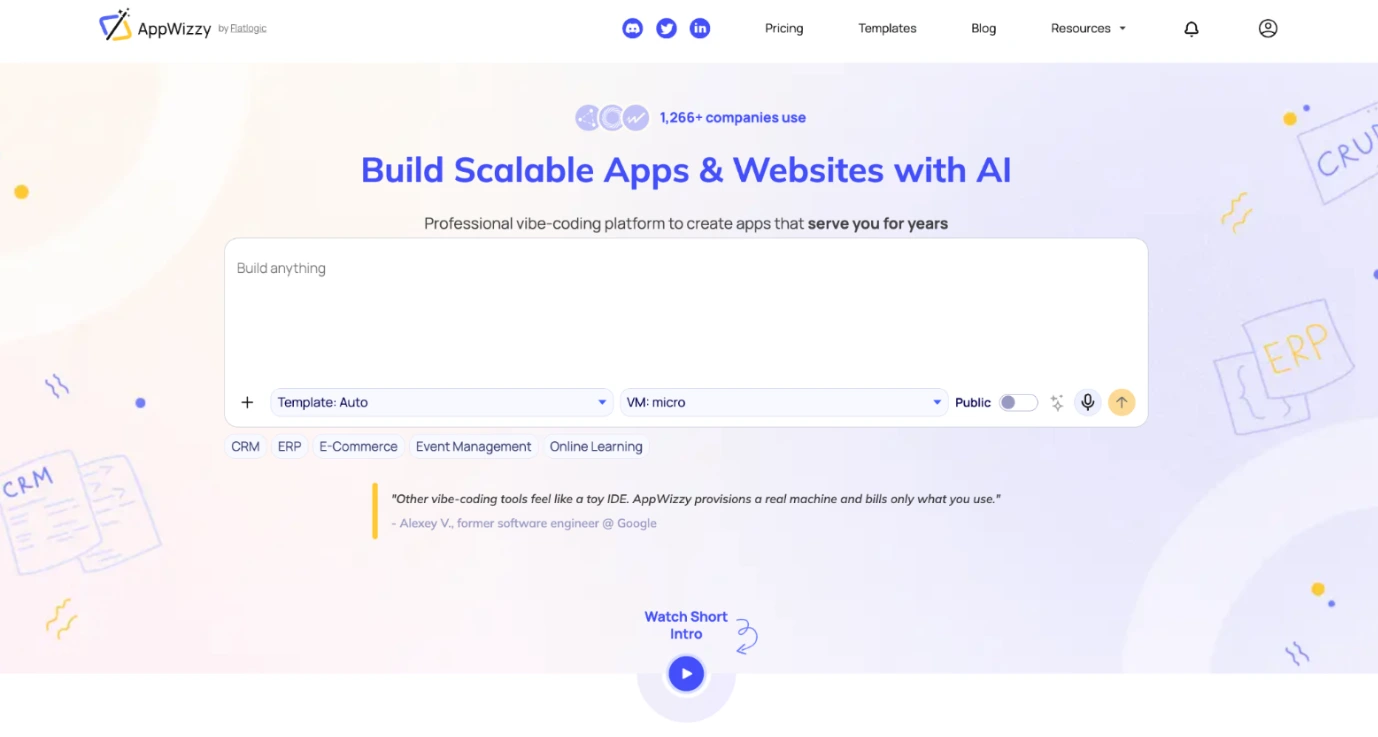 Appwizzy has quickly emerged as one of the most promising AI agent platforms in 2026 by focusing on autonomous business automation and AI-powered app creation.
Unlike traditional assistants that only respond to prompts, Appwizzy enables users to create AI agents capable of handling real operational workflows with minimal technical knowledge. The platform combines no-code automation, intelligent workflow orchestration, and AI-driven decision-making into a single ecosystem.
One of Appwizzy’s biggest strengths is accessibility. Businesses can deploy AI agents without building complex infrastructure or hiring large engineering teams.
Target Audience
Small and medium businesses
Startups
Operations teams
Non-technical business users
Workflow automation teams
Key Features
No-code AI workflow builder
Autonomous task automation
Business process optimization
AI-powered integrations
Internal operations automation
Pitfalls
Limited customization for highly complex enterprise systems
Advanced automations may still require technical setup
Smaller ecosystem compared to Microsoft or Google
Pricing
Appwizzy offers custom pricing based on workflow volume, integrations, and business requirements. Most plans are subscription-based with scalable enterprise options.
Vendasta’s AI Workforce
Vendasta’s AI Workforce is designed to help businesses automate core operations by deploying specialized AI employees across marketing, sales, and customer support. Unlike traditional AI tools that assist with isolated tasks, this platform enables end-to-end workflow execution, including lead capture, customer engagement, and data-driven decision-making. With roles like AI Receptionist, AI Sales Assistant, and AI Support Agent, businesses can reduce manual effort, improve response times, and scale operations efficiently without building complex AI systems from scratch.
Target Audience
Small and mid-sized businesses
Local service providers
Sales and marketing teams
Customer support teams
Agencies
Key Features
AI employees for business functions
End-to-end workflow automation
Lead capture and appointment booking
CRM and customer interaction management
Review and reputation management
Pitfalls
May require initial setup and integration
Best suited for SMB and service-based businesses
Limited flexibility compared to custom-built AI systems
Pricing
Subscription-based pricing based on usage and business needs
Invideo Agent
Invideo agent is an AI video creation platform that helps creators and businesses turn ideas into complete videos. Users can provide a simple video prompt, and the platform helps generate scripts, AI visuals, voiceovers, subtitles, music, and a structured video workflow.
The platform simplifies video production by bringing multiple creation steps into one process. Instead of managing scripting, visual sourcing, narration, and editing separately, creators can use invideo agent to create videos with AI by describing their idea and refining the generated output.
Target Audience
Content creators
Marketers and businesses
Social media teams
Educators
Small businesses creating video content
Key Features
AI-generated video scripts
AI-created visuals and scenes
Automated voiceovers and subtitles
Background music integration
Prompt-based video creation
Video generation for marketing, education, and social content
Pitfalls
Complex storytelling may still require manual refinement
AI-generated visuals may need adjustments for brand consistency
Highly specific creative directions may require multiple iterations
Pricing
Invideo Agent offers plans based on usage requirements, generation limits, and additional AI video creation features.
OpenAI Operator
OpenAI Operator is one of the most advanced autonomous AI agents available in 2026. It can browse websites, interact with online tools, complete forms, summarize information, and automate multi-step digital workflows. The platform combines strong reasoning capabilities with real-time browser interaction, making it useful for both personal productivity and enterprise automation.
Operator is deeply integrated into the OpenAI ecosystem, allowing users to connect AI conversations, coding tools, and automation tasks within a single environment. Many organizations use it for research, workflow automation, and operational support. Its rapid ecosystem growth has made it one of the most influential AI agent platforms in the industry.
Target Audience
Enterprises
Researchers
Operations teams
Productivity-focused professionals
AI power users
Key Features
Autonomous browser interaction
Workflow automation
Research assistance
Multi-step task execution
Strong reasoning and planning
Pitfalls
Requires human supervision for sensitive tasks
Complex workflows may occasionally fail
Enterprise integrations can become expensive
Pricing
Pricing varies depending on usage, API access, and enterprise integrations. OpenAI primarily offers subscription and API-based pricing models.
Anthropic Claude Code
Claude Code is an AI coding agent focused on software engineering workflows and large-scale codebase understanding. It became especially popular due to its large context window and reliable reasoning abilities in programming tasks. Developers use Claude Code for debugging, documentation generation, code refactoring, test writing, and reviewing claude code security practices across a codebase.
The platform performs particularly well when handling large repositories and long technical conversations. Unlike traditional autocomplete assistants, Claude Code behaves more like an engineering collaborator capable of understanding broader project structures. In 2026, it remains one of the strongest AI coding assistants available.
Target Audience
Software engineers
Development teams
Technical writers
DevOps teams
Engineering managers
Key Features
Large context window
Codebase analysis
Bug fixing assistance
Documentation generation
Test automation
Pitfalls
Still requires human code review
Can produce incorrect implementations
Not ideal for highly proprietary systems without safeguards
Pricing
Anthropic offers API-based pricing and enterprise subscriptions depending on model usage and context size.
Read Also: OTT Development: Building the Future of Digital Streaming Platforms
Devin by Cognition
Devin is an autonomous AI software engineering agent developed by Cognition. It is designed to complete structured development tasks with minimal supervision, including coding, debugging, repository management, and CI/CD operations. Devin gained significant attention for positioning itself as an "AI software engineer", although practical use cases still require human oversight.
The platform works best in controlled development environments where tasks are clearly scoped. Developers often use Devin for repetitive engineering workflows and automation-heavy projects. In 2026, it remains one of the most ambitious AI engineering agents on the market.
Target Audience
Software companies
Engineering teams
Startups
Technical operations teams
AI-native development teams
Key Features
Autonomous coding workflows
Repository management
CI/CD integration
Persistent task handling
Multi-step engineering automation
Pitfalls
Not reliable enough for unsupervised production deployment
Complex projects may confuse the agent
Expensive for smaller teams
Pricing
Pricing is enterprise-focused and generally customized based on infrastructure and usage needs.
Microsoft Copilot Studio
Microsoft Copilot Studio enables organizations to create custom AI agents integrated into Microsoft’s enterprise ecosystem. The platform connects with Microsoft 365, Teams, Azure, Dynamics, and Windows services, making it highly attractive for large organizations already using Microsoft infrastructure.
Businesses can automate internal workflows, customer support, HR operations, and reporting tasks using AI agents. Microsoft places strong emphasis on enterprise security, governance, and compliance. Copilot Studio is becoming a major platform for enterprise AI transformation in 2026. Its deep integration capabilities make it particularly valuable for large-scale organizations.
Target Audience
Enterprises
Corporate IT departments
HR teams
Operations teams
Microsoft ecosystem users
Key Features
Microsoft 365 integration
Enterprise AI agent creation
Workflow automation
Compliance and governance tools
Azure integration
Pitfalls
Heavy dependence on Microsoft ecosystem
Complex licensing structure
Can become expensive at enterprise scale
Pricing
Microsoft uses subscription-based enterprise pricing tied to Microsoft ecosystem products and AI usage.
Google Gemini Agents
Google Gemini Agents extend Google’s AI ecosystem into autonomous workflows and enterprise productivity automation. Integrated across Google Workspace, Android, Search, and Cloud services, Gemini Agents excel at research-heavy tasks and multimodal processing. The platform leverages Google’s search infrastructure to provide strong real-time information retrieval capabilities.
Organizations use Gemini Agents for document processing, productivity automation, and knowledge management. Its multimodal abilities allow the system to process text, images, and structured data efficiently. In 2026, Gemini will remain one of the strongest AI ecosystems globally.
Target Audience
Enterprises
Google Workspace users
Research teams
Productivity-focused businesses
Knowledge management teams
Key Features
Multimodal AI capabilities
Research automation
Workspace integration
Real-time information retrieval
Document processing
Pitfalls
Privacy concerns around cloud integrations
Enterprise setup may require technical expertise
Some advanced features remain ecosystem-dependent
Pricing
Google offers subscription-based pricing alongside enterprise cloud contracts and API-based usage fees.
LangGraph
LangGraph is a framework designed for building stateful, production-grade AI agent systems. Rather than serving as a consumer assistant, it provides developers with tools for orchestrating multiple agents, workflows, memory systems, and human approval layers. The framework became highly popular due to the growing demand for reliable AI orchestration infrastructure.
Developers use LangGraph to build advanced automation systems capable of handling complex decision trees and collaborative agent workflows. Its flexible graph-based architecture supports scalable AI deployment. In 2026, LangGraph is considered foundational infrastructure for enterprise AI agents.
Target Audience
AI engineers
Developers
Enterprise AI teams
Infrastructure teams
Multi-agent system builders
Key Features
Stateful workflows
Multi-agent orchestration
Human-in-the-loop controls
Scalable AI infrastructure
Flexible execution graphs
Pitfalls
Requires technical expertise
Not beginner-friendly
Deployment complexity can be high
Pricing
LangGraph offers open-source components alongside commercial enterprise infrastructure and support options.
CrewAI
CrewAI is a multi-agent collaboration framework that enables specialized AI agents to work together as coordinated teams. Instead of relying on a single general-purpose AI system, CrewAI organizes multiple agents into roles such as researchers, analysts, writers, and reviewers. This structure mirrors real organizational workflows and allows for more scalable task management.
Businesses use CrewAI for research automation, content production, and operational workflows. The framework gained significant traction because multi-agent collaboration became one of the biggest AI trends of 2026. It is especially popular among startups experimenting with autonomous teams.
Target Audience
Startups
AI developers
Research teams
Automation-focused businesses
Multi-agent workflow designers
Key Features
Multi-agent collaboration
Role-based AI systems
Workflow orchestration
Task delegation
Autonomous coordination
Pitfalls
Requires careful workflow design
Multi-agent systems can become unstable
Debugging collaborative workflows is challenging
Pricing
CrewAI provides open-source tooling alongside paid enterprise deployment and support options.
Zapier AI Agents
Zapier AI Agents extend Zapier’s automation platform into AI-driven workflow orchestration. The platform allows businesses to create autonomous automations using no-code tools and thousands of third-party integrations. Companies can deploy AI agents for lead management, support automation, marketing workflows, and CRM synchronization.
Its ease of use makes it especially attractive for non-technical users and small businesses. Zapier’s massive integration ecosystem remains one of its strongest competitive advantages. In 2026, it is considered one of the easiest ways to adopt AI automation quickly.
Target Audience
Small businesses
Marketing teams
Non-technical users
Operations teams
Workflow automation specialists
Key Features
No-code AI automation
Thousands of integrations
Workflow orchestration
CRM automation
Marketing automation
Pitfalls
Limited advanced reasoning capabilities
Complex workflows can become difficult to manage
Usage-based costs may scale quickly
Pricing
Zapier offers tiered subscription pricing based on automation volume, integrations, and AI usage.
AutoGen by Microsoft Research
AutoGen is a framework developed by Microsoft Research for creating collaborative AI agent ecosystems. It enables agents to communicate, delegate tasks, debate solutions, and coordinate workflows autonomously. Developers use AutoGen to experiment with advanced multi-agent architectures across research, coding, and operational automation tasks.
The framework played a major role in popularizing collaborative AI systems and agent-to-agent communication. Its flexibility makes it valuable for experimentation and enterprise AI research. In 2026, AutoGen remains highly influential among AI infrastructure developers.
Target Audience
AI researchers
Developers
Enterprise AI teams
Experimental AI labs
Multi-agent system architects
Key Features
Agent collaboration
Autonomous task delegation
Multi-agent conversations
Flexible orchestration
Experimental AI infrastructure
Pitfalls
High technical complexity
Requires strong engineering expertise
Production reliability can vary
Pricing
AutoGen is primarily open-source, though enterprise implementations may involve infrastructure and support costs.
Summing Up
AI agents are evolving from simple assistants into operational systems capable of executing meaningful business workflows. The biggest trend in 2026 is not just conversational intelligence, but autonomous execution and multi-agent collaboration.
From enterprise ecosystems like Microsoft Copilot Studio and Google Gemini to developer-focused frameworks like LangGraph and AutoGen, the AI agent landscape is becoming increasingly diverse. Meanwhile, platforms like Appwizzy and Zapier AI Agents are making AI automation more accessible for non-technical businesses.
Organizations that successfully integrate AI agents into their workflows today may gain a significant competitive advantage in the coming years.
For enterprises specifically looking to deploy secure AI chat assistants and automate internal workflows without compromising on compliance, Langdock is worth exploring it supports multiple AI models including Claude and GPT, with SOC 2 and GDPR compliance built in.