
A developer friend of mine casually mentioned last week that the verification text his app sends when someone signs up isn't actually coming from his own servers at all, it's Twilio quietly handling that in the background. I hadn't thought about how many of the texts and calls I get daily are secretly running through the exact same infrastructure.
So I went and looked into what is Twilio properly, what it actually does under the hood, who's using it, and how the pricing model works. Here's the complete picture.
What Is Twilio, Really
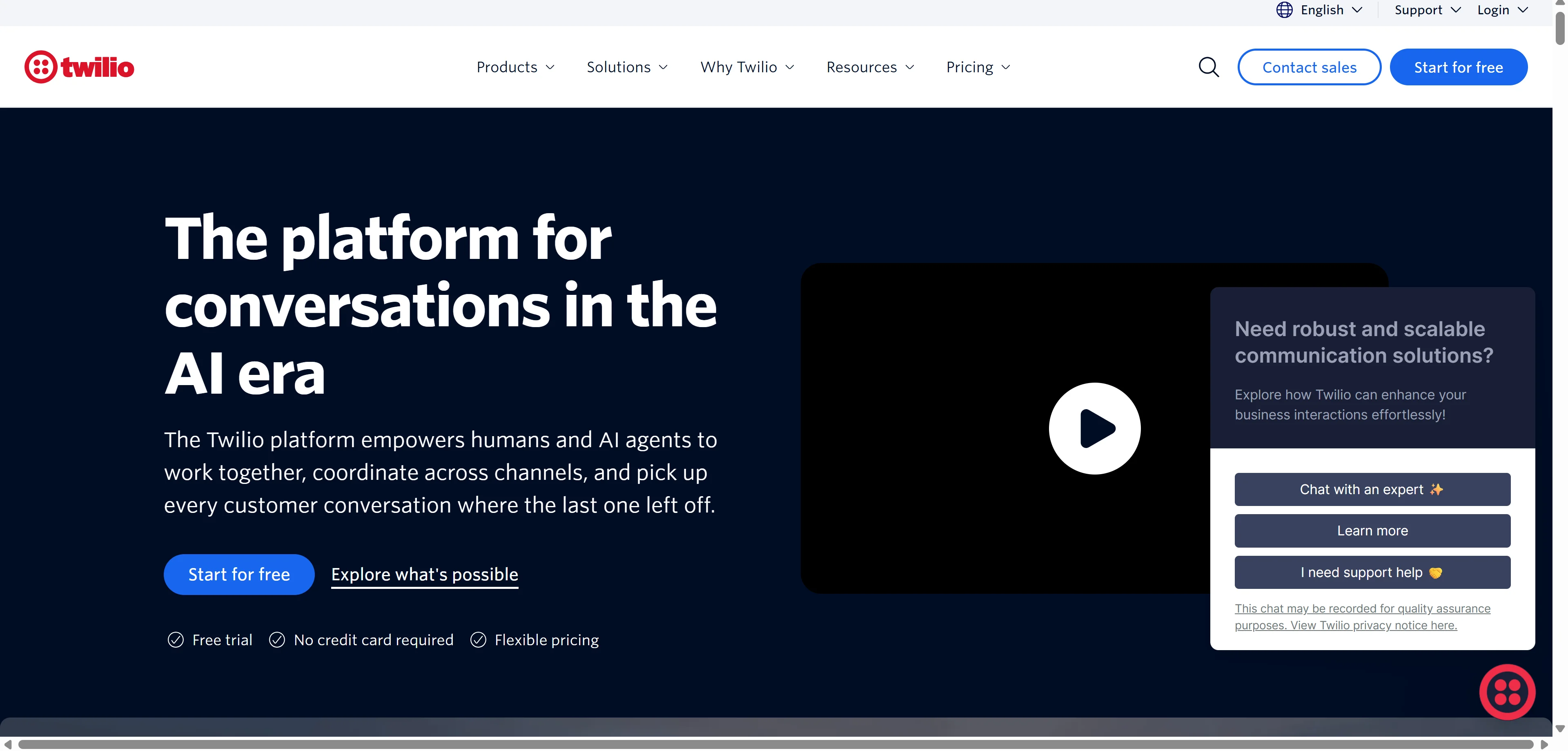
Twilio is a cloud communications platform that lets businesses add voice, SMS, WhatsApp, email, video, and chat to their apps, websites, and CRMs through a set of APIs. Instead of a company building and maintaining its own telecom infrastructure from scratch, its developers call Twilio's APIs and a message sends or a call connects in a few lines of code.
Twilio (NYSE: TWLO) is headquartered in San Francisco, led by CEO Khozema Shipchandler, and carries a market cap of around $30 billion as of mid-2026. The company was founded back in 2008 with a straightforward mission, take the genuinely complex global telecom network and make it accessible through code instead of carrier contracts and hardware.
 Who's Actually Using It
Here's the part that surprised me a little. Twilio's platform powers communications for Uber, Airbnb, Netflix, Intuit, and HubSpot, alongside a huge range of smaller companies you've likely never heard of directly. That's the whole point of infrastructure like this, it works invisibly in the background, so unless you go looking specifically, you'd never know it's there.
From startups to Fortune 500 companies, organizations rely on this kind of programmable communication to engage customers, automate workflows, and manage support without hiring an entire team just to negotiate with phone carriers.
How Twilio Actually Works Under the Hood
Your application sends requests to Twilio's APIs, Twilio handles the communication layer, and your software receives status updates, replies, and event data back through webhooks. That's the practical, plain-English version of how the whole thing functions.
In slightly more technical terms, the Twilio API is a set of RESTful endpoints and SDKs providing programmatic access to communication services, letting your app or system trigger operations like sending a text, placing a call, or verifying a phone number using standard HTTP requests. Twilio handles the underlying telephony infrastructure and carrier relationships entirely on its end, abstracting all of that complexity away from the people actually building the application.
What You Can Actually Build With It
Twilio isn't one single product, it's a family of APIs that each solve a specific communication problem.
Voice lets applications programmatically make and receive phone calls. Messaging covers SMS, MMS, RCS, and WhatsApp, the channel that probably sends you the most Twilio-powered content without you ever noticing. Twilio Verify handles two-factor authentication and one-time PIN delivery, exactly the kind of code you get texted when logging into a banking app.
Twilio Flex is a programmable cloud contact center platform, letting companies build custom customer support experiences rather than using a rigid, prebuilt call center tool. Twilio Studio is a visual, no-code workflow builder for people who want to design communication logic without writing raw code line by line. Video covers real-time video chat integration, and SendGrid, Twilio's email product, handles transactional and marketing email delivery at scale.
Is Twilio a CRM
No, and this is genuinely worth clarifying since it's a common point of confusion. Twilio is not a CRM itself. It integrates with CRMs like HubSpot to enable calling, SMS, and WhatsApp directly inside the CRM interface, with calls recorded and logged against contact records automatically.
Think of it this way. Your CRM stores customer information and manages relationships. Twilio is the plumbing that actually sends the message or connects the call when your CRM, or any other piece of software, needs to reach a real person through a real communication channel.
The Segment Decision Worth Knowing About
Here's a business detail that's genuinely relevant if you're evaluating Twilio's broader ecosystem. After an operational review in 2024 prompted by activist investors, Twilio decided to retain Segment, its Customer Data Platform, rather than spinning it off or selling it, choosing instead to integrate it more deeply across the wider product suite.
That matters because Segment specifically handles unifying customer data across different tools and channels, which pairs naturally with Twilio's communication APIs if a business wants messaging decisions informed by actual customer behavior data rather than sending communications blind.
How Twilio Pricing Actually Works
Twilio runs on a pay-as-you-go model, charging per message, per call minute, or per verification, with rates varying by channel and country. There's no upfront license fee for the core APIs, which is exactly why it's approachable for small development teams testing an idea, not just large enterprises with dedicated telecom budgets.
High-volume users typically negotiate committed-use discounts through a Twilio Partner over a 12-month term once their usage justifies that kind of arrangement. Add-on products like Flex and SendGrid carry their own separate usage-based pricing structures on top of the core messaging and voice costs.
I want to be honest with you that I'm not going to hand you specific per-message or per-minute rates here, since those genuinely vary by country and channel and shift over time. If exact current pricing matters for a real decision you're making, check directly through Twilio's own pricing pages rather than trusting a number that might already be stale.
Where Twilio Fits in a Broader Security and Infrastructure Picture
Twilio Verify specifically sits inside a bigger conversation about how businesses secure access and confirm identity across their systems, not just how they send a text message. If you're thinking about business communication infrastructure alongside broader access security for your team or contractors.
The Practical Use Cases People Actually Build
Two-factor authentication is probably the single most common Twilio use case, sending SMS codes for account security during login. Automated appointment reminders, delivery notifications, and customer support routing all run through similar infrastructure. Businesses building chatbots or conversational AI experiences increasingly layer that logic on top of Twilio's messaging channels rather than building separate infrastructure for each communication type.
AI-generated text shows up in plenty of other contexts too, not just chatbots. Our comparison of TextToHuman vs Undetectable AI covers tools built for a completely different problem, making AI-written content read more naturally, unrelated to Twilio's infrastructure but a common AI-adjacent topic.
For anything requiring verified, reliable delivery across multiple countries and channels without a company building carrier relationships themselves, this is the kind of problem Twilio was specifically built to solve.
Industry Recognition Worth Knowing
Twilio has been named a Leader for the fifth time in IDC MarketScape's assessment of the CPaaS category, and it's also recognized in Gartner's Magic Quadrant for Communications Platform as a Service. That consistency over multiple years of independent industry evaluation is a reasonable signal of sustained platform maturity, not just a single good year.
For the most current, authoritative technical reference on exactly what the platform supports and how the APIs are structured, Twilio's own official documentation is the source worth bookmarking directly, since it updates continuously as products evolve.
My Honest Take
Twilio solved a genuinely unglamorous but important problem. Building reliable, global telecom infrastructure from scratch is expensive and slow, and most companies have no real reason to do it themselves when an API can handle it instead. That's exactly why it quietly powers so much of the SMS and call activity you interact with daily without ever seeing the Twilio name attached to any of it.
If you're a developer or a business evaluating how to add real communication features to a product, understanding that this is infrastructure you're renting, not a CRM or a finished customer engagement tool, sets your expectations correctly from the start.
FAQs
What is Twilio used for?
Adding voice calls, SMS, WhatsApp, email, and video communication into apps and websites through APIs, without building telecom infrastructure from scratch.
How does Twilio work?
Your application sends API requests to Twilio, Twilio handles the actual telecom and carrier layer, and your software receives status updates and events back through webhooks.
Is Twilio a CRM?
No, Twilio is not a CRM. It integrates with CRMs like HubSpot to add calling, SMS, and WhatsApp functionality directly inside them.
How much does Twilio cost?
It runs on a pay-as-you-go model, charging per message, call minute, or verification, with rates varying by channel and country and no upfront license fee.
What companies use Twilio?
Uber, Airbnb, Netflix, Intuit, and HubSpot are among the notable companies using Twilio's platform for customer communications.