
A BCBA I know spent eight months evaluating software after her clinic outgrew spreadsheets. She wasn't just comparing feature lists. She was trying to figure out which vendor would still exist and still care about her practice in five years, because switching clinical software mid-stream is genuinely painful for staff and clients alike.
That ownership and stability question is exactly what most Aloha ABA reviews skip entirely. Here's the complete picture, including the part competitor articles leave out.
What Is Aloha ABA?
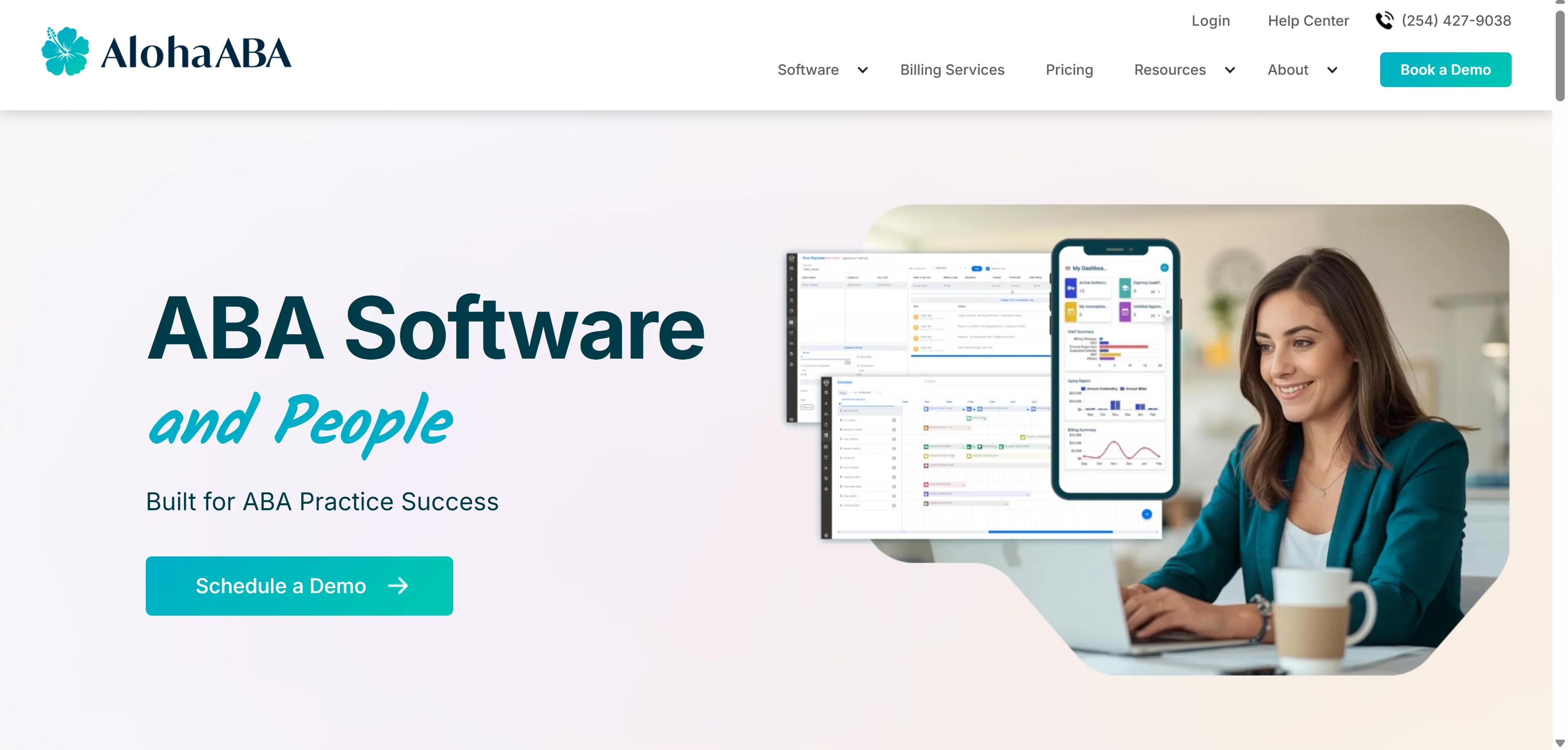
AlohaABA is a cloud-based practice management platform designed specifically for ABA and autism therapy clinics, unifying scheduling, billing, payroll, and Electronic Medical Records into one centralized system.
The platform serves ABA therapy clinics, private practitioners, multi-clinic organizations, and behavioral health agencies. It's built primarily for small ABA and therapy providers, with 93 percent of reviewers coming from small businesses.
The team behind it includes BCBAs, RBTs, ABA billing specialists, and software developers, several of whom are also parents of children on the autism spectrum. That clinical background shapes the product in ways generic practice management software from outside the ABA space simply doesn't replicate.
 The Core Features Breakdown
Let me walk through what you actually get inside the platform.
Appointment Scheduling
You can plan individual or group appointments, view multiple staff schedules simultaneously, and add upcoming sessions without switching screens. For clinics juggling RBT supervision requirements alongside client sessions, that multi-schedule view genuinely saves time.
Billing and Claims Management
The platform auto-generates payer-ready claims using scheduled sessions, attaches CPT and HCPCS codes, and suggests modifiers automatically. Live eligibility verification checks coverage before a claim submits, catching missing pre-authorizations early.
Clinics that turn on pre-authorization reminders often see denial rates drop by 25 to 30 percent. That's a meaningful revenue cycle improvement for practices drowning in payer complexity.
Payroll Management
Work hours are tracked using Google Maps integration to verify staff were actually at the location they billed for. Customizable employee permissions let staff manage their own hours, which reduces the administrative back-and-forth that eats up office manager time.
Welina: The Clinical Data System
AlohaABA's newer clinical data collection tool, Welina, was built specifically with BCBA input to record Skill Acquisition, Behavior Reduction, and ABC data in real time during sessions. Core graph types work immediately for on-the-spot clinical decision-making.
This matters because many ABA platforms treat data collection as an afterthought bolted onto billing software. Welina was designed the opposite way, prioritizing in-session flow so clinicians stay present with clients instead of buried in a screen.
Pricing: What You'll Actually Pay
Here's the current pricing structure as of 2026.
Plan | Price | What It Covers |
|---|---|---|
Practice Management | $29.99 per staff/month | Scheduling, billing, payroll, EMR |
One Simple Solution bundle | $39.99 per client/month | Full integrated package |
Data Collection add-on | $12 per client/month | Welina clinical data tools |
Many practices report saving around 30 percent compared to market averages by consolidating onto one platform rather than paying for separate scheduling, billing, and data collection tools.
The Ownership Question Nobody Else Is Asking
Here's the value most Aloha ABA articles completely skip, and I genuinely think it's the most important consideration for a healthcare software decision in 2026.
Software disruption in ABA is more than an inconvenience. It can impact billing continuity, staff workflows, and client care directly. Understanding who owns the organization and what their long-term objectives are is part of responsible due diligence.
Why This Matters More in ABA Than Almost Any Other Software Category
Healthcare and behavioral health software has seen aggressive private equity consolidation over the past several years. When a clinical vendor gets acquired, the acquiring company frequently prioritizes cutting costs and consolidating product lines over the specific needs of small ABA practices, sometimes forcing painful migrations or feature removals.
AlohaABA remains privately held and closely tied to the ABA community, with a stated mission centered on sustainable practice growth rather than aggressive consolidation. That's worth weighing seriously against competitors backed by private equity firms with different incentive structures.
The company's acceptance as a Business Affiliate of the Council of Autism Service Providers reinforces this positioning. CASP's affiliate program specifically screens for organizations that demonstrate meaningful support for provider organizations rather than purely extracting revenue from the space. You can review CASP's own standards for provider organizations at the Council of Autism Service Providers, which is the recognized trade association setting best-practice benchmarks across ABA services.
What This Means for Your Decision
Before signing with any ABA software vendor, ask directly who owns the company, whether they've raised institutional investment that creates pressure for rapid growth or exit, and what happens to your data and workflows if ownership changes. Few practices ask these questions during a sales demo, and it's exactly the kind of due diligence that prevents a forced migration eighteen months into your contract.
The Honest Limitations
No platform is perfect, and here's what real user reviews consistently flag.
There's no mobile app. The mobile browser experience works but lacks the full desktop feature set, which matters if your staff need to log session notes primarily from phones in the field.
Scheduling and calendar navigation can feel slow when moving between different sections of the platform, a complaint that shows up across multiple review platforms. Billing reports can also look inconsistent in the calendar view since they're based on actual session time rather than billable units, which takes some adjustment.
Secondary billing and concurrent billing adjustments have limitations some larger practices have run into, so multi-payer clinics with complex secondary insurance workflows should test this specifically during a trial before committing.
Who Should Use Aloha ABA
Small to mid-sized ABA clinics that want scheduling, billing, payroll, and clinical data in one connected system without enterprise-level cost or complexity are the clearest fit. Startups and practices switching from spreadsheets or fragmented tools consistently report a smooth, well-supported onboarding.
Practices that value long-term vendor stability and community alignment over the lowest possible price point should weigh the privately-held ownership structure as a genuine positive.
Who Should NOT Use Aloha ABA
Large multi-location enterprises with highly complex secondary billing needs may hit real limitations that smaller practices won't encounter. If your staff work primarily from mobile devices in the field and need full feature parity there, the absence of a dedicated app is a genuine gap, not a minor one.
Practices that have already invested heavily in a separate clinical data platform and only want billing software should evaluate whether the bundled pricing model still makes sense, since you may be paying for data collection features you won't use.
How It Compares to the Main Alternatives
CentralReach is the enterprise-grade incumbent many practices switch away from specifically for cost and flexibility reasons, based on user reviews referencing exactly that migration. Ensora Health, Motivity, and Hi Rasmus compete primarily on the clinical data collection side rather than full practice management.
The honest differentiator for AlohaABA is the combination of clinical BCBA input, privately-held ownership stability, and pricing that consistently comes in below market averages for comparable feature depth.
Getting Started
Request a demo directly through AlohaABA's site, and come prepared with specific questions about your current billing pain points, your secondary payer mix if applicable, and the ownership stability questions covered above. Most practices complete onboarding within a few weeks, with staff typically comfortable with core scheduling within 30 to 45 minutes of training.
For practices managing distributed clinical staff across multiple locations, the same operational discipline that makes workforce platforms effective applies directly here too. We covered how role-based access and scheduling complexity plays out in a different but structurally similar workforce context in our BeeForce by BlueTree review, which is worth reading if you're managing staff across multiple ABA clinic locations.
FAQs
Is Aloha ABA good for small practices?
Yes, it's specifically built for small to mid-sized ABA clinics, with 93 percent of reviewers coming from small businesses.
Does Aloha ABA have a mobile app?
No, it currently offers no dedicated mobile app, only a mobile browser experience with fewer features than desktop.
How much does Aloha ABA cost?
Practice Management runs $29.99 per staff monthly, with a bundled option at $39.99 per client monthly plus a $12 data collection add-on.
Who owns Aloha ABA?
The company remains privately held and closely tied to the ABA community rather than backed by private equity consolidation.
What is Welina in Aloha ABA?
Welina is Aloha's real-time clinical data collection tool for recording Skill Acquisition, Behavior Reduction, and ABC data during live sessions.