
My uncle opened a second location of his clothing store last year. Within two months he was drowning. Inventory was out of sync between stores, staff scheduling was a mess, and he had no idea which products were actually selling well across both locations.
I sat down with him, looked at what was available, and spent a week going through the main options. Here's everything I found broken down properly.
What Retail Management Software Actually Does
Let me break this down simply. Retail management software is one platform that handles everything your store runs on.
Physical stores also increasingly pair this with video management software for loss prevention and staff safety worth a look at our best video management software solutions if security cameras and surveillance are part of your setup.
The whole point is that instead of running five separate tools that don't talk to each other, everything lives in one place. One dashboard. One source of truth.
From what I saw, the businesses that switch to a proper retail management system don't just save time. They actually understand their numbers for the first time.
The Core Features That Actually Matter
Before I get into specific tools, here's what I was evaluating across every platform.
POS system quality. The checkout experience has to be fast and reliable. If the POS slows down or crashes during a busy period, everything else becomes irrelevant.
Inventory management depth. Can it track variants like sizes and colors? Does it support multiple locations? Can it auto-generate purchase orders when stock runs low? These questions separate basic tools from serious ones.
Reporting and analytics. Sales by product, by category, by staff member, by time of day. The more granular the data, the better decisions you can make.
Multi-location support. If you have or plan to have more than one store, this is non-negotiable. Not every tool handles it well.
Integrations. QuickBooks for accounting, Shopify or WooCommerce for ecommerce, Mailchimp for marketing. The more your retail software connects with your existing stack, the less manual work you're doing.
Ease of use. A feature-rich tool your staff finds confusing is worse than a simpler one they actually use properly.
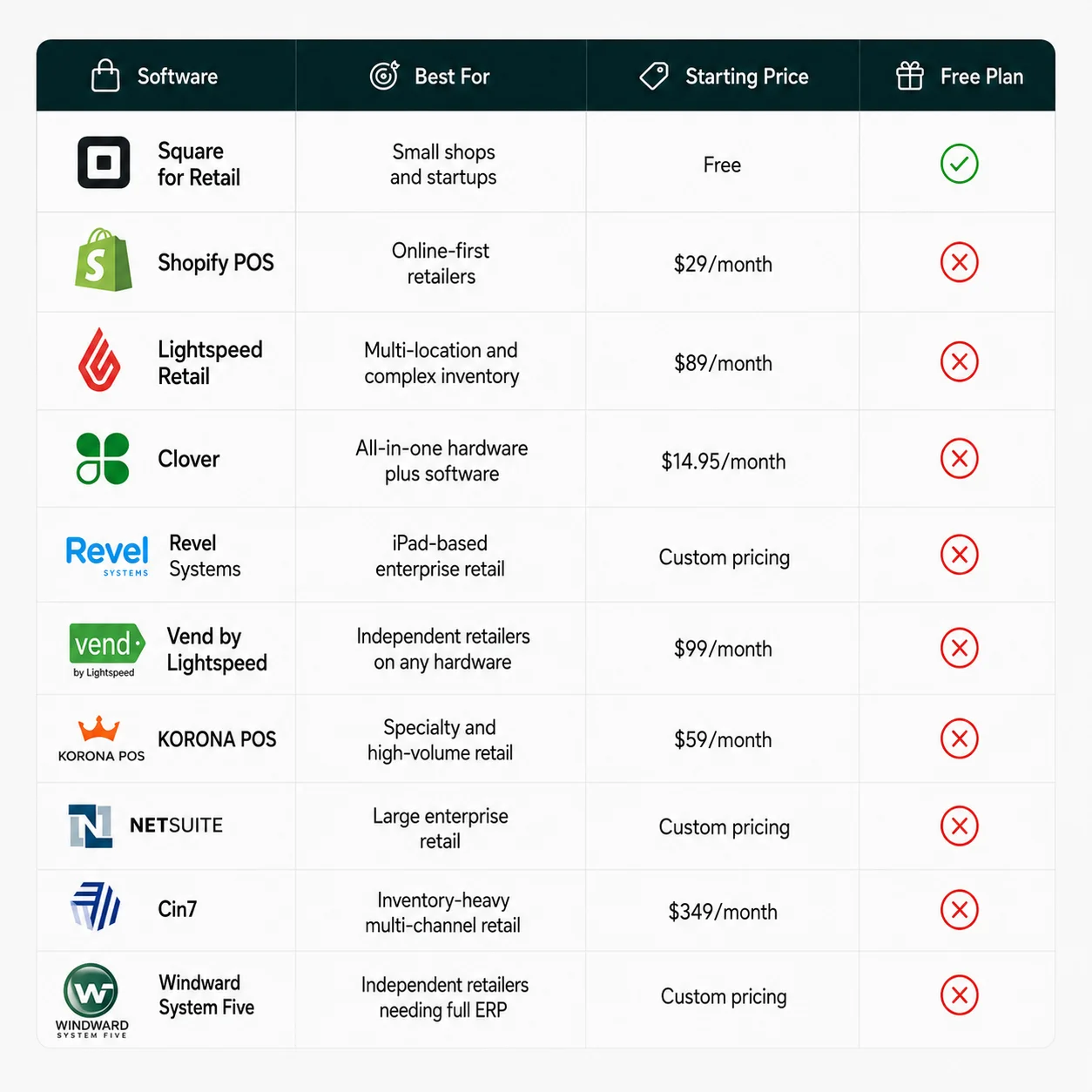
Quick Comparison at a Glance
 1. Square for Retail: Best for Small Shops Starting Out
Square is where I'd send anyone opening their first store or running a small operation with a tight budget.
The free plan is genuinely functional. You get a POS, basic inventory tracking, sales reports, and a free online store included. That's a real offer.
Square wins on price transparency, ease of use, and speedy onboarding, making it ideal for very small retailers, pop-ups, and solo operators who need to get selling quickly with minimal configuration.
The hardware is affordable too. A card reader starts under $50. The Square Register hardware kit with cash drawer and printer runs around $1,189 if you want the full setup.
Hardware pricing is just one part of the story licensing costs can multiply your total spend significantly. If your retail setup also includes cloud security cameras, our Verkada pricing guide walks through exactly how hardware plus licensing adds up before you commit to a system.
The limitations show up as you scale. Users note limited reporting and inventory management features, lacking the depth and customization offered by competitors like Shopify POS or Clover.
But for a boutique, a pop-up shop, or a single-location small retailer just getting started, Square removes every barrier to entry.
Pricing: Free for the core plan. Square for Retail Plus starts at $89/month per location.
2. Shopify POS: Best for Online-First Retailers Expanding to Physical
If you already sell online through Shopify and you're opening a physical location, Shopify POS is the most natural move you can make.
The integration between the ecommerce side and the in-store POS is seamless. One inventory pool, one customer database, one reporting dashboard covering both channels. No syncing, no reconciling.
Shopify started out as an ecommerce-first platform and has evolved to offer very comprehensive and flexible POS features tightly integrated with its powerful store-building tools.
Shopify POS offers the best ecommerce features in this category, with unique social media integrations and digital marketplaces, making it much more suitable for businesses that see selling online as a core part of their business.
That marketplace strategy matters more than ever — see our breakdown of how selling on Walmart just got smarter if you're weighing which third-party marketplaces to prioritize alongside your retail software.
The downside is that pure in-store features aren't as deep as Lightspeed. If you're brick-and-mortar first with minimal online presence, Shopify is probably more than you need.
Pricing: Online plans start at $29/month. POS Pro for physical locations adds $89 per location per month on top of that.
3. Lightspeed Retail: Best for Multi-Location and Complex Inventory
Lightspeed is the tool I'd point my uncle toward. It's built specifically for retailers who have grown past the basics and need serious inventory control.
Lightspeed Retail wins for inventory-heavy retailers needing multi-location tools and advanced reporting.
The matrix inventory system handles variants, SKUs, and vendor catalogs better than most tools at this price point. If you sell apparel with sizes and colors, sporting goods with multiple configurations, or any product with lots of variants, Lightspeed handles this without forcing you into workarounds.
Lightspeed Retail generally offers more advanced, granular inventory management and reporting features suitable for complex retail operations including serialized items and purchase order workflows.
The learning curve is real though. Smaller shops may find the pricing and feature depth more than they need, and the best tools are locked behind higher-tier plans.
If you're an established retailer with multiple locations and complex inventory, Lightspeed pays for itself. If you're just starting out, it's probably overkill.
Pricing: Basic starts at $89/month. Core at $149/month adds ecommerce and multi-location. Plus at $289/month adds loyalty and advanced analytics. All annual billing.
4. Clover: Best for All-in-One Hardware and Software
Clover is what comes up when retailers want the hardware and the software to come from the same place without assembling a setup themselves.
You pick a Clover hardware configuration, the software is already built for it, and you're processing payments and managing inventory within hours of setting it up.
The app marketplace is genuinely useful. You can add employee scheduling, loyalty programs, gift cards, online ordering, and dozens of other capabilities through third-party apps without switching platforms.
From what I saw, Clover works best for retailers who want simplicity in setup and don't want to deal with hardware compatibility questions. The trade-off is that inventory management depth is behind Lightspeed, and you're locked into Clover's payment processing which carries higher rates for some business types.
Pricing: Starter plans from $14.95/month with hardware purchased separately or bundled.
5. Revel Systems: Best for iPad-Based Enterprise Retail
Revel Systems is an iPad-native retail management platform built for larger operations that want the flexibility of tablet hardware without sacrificing enterprise-grade features.
It handles complex inventory, employee management, customer loyalty, kitchen display systems for food-adjacent retail, and detailed analytics all within one platform.
From what I saw, Revel gets mentioned consistently in enterprise retail discussions because it scales across dozens of locations without losing control of data. The centralized management console lets you push menu and pricing changes across every location simultaneously.
The pricing is custom and requires a conversation with their sales team. That tells you upfront this isn't a small business tool. It's for established retailers with real operational complexity and the budget to match.
Pricing: Custom pricing. Requires demo and quote.
6. KORONA POS: Best for Specialty and High-Volume Retail
KORONA POS is the one that comes up when people in specialty retail, like gift shops, wineries, museums, and ticket-based venues, start asking what's built for them specifically.
KORONA POS offers innovative point of sale software with unique features built for retailers, ticketing and event operations, and quick-service retailers, with automatic updates, 24/7 in-house customer support, and zero contracts, fees, or surcharges.
That no-contract model is worth noting. Most enterprise-adjacent POS platforms lock you in. KORONA doesn't.
The reporting and inventory analysis features are solid and detailed. Promotions, loyalty programs, employee management, and multi-store management are all included without needing to buy add-ons.
From what I saw it's particularly strong for high-volume single-location retailers who need serious reporting depth without paying Lightspeed-level prices.
Pricing: Core plan starts at $59/month. Retail plan at $69/month. No contracts.
7. Vend by Lightspeed: Best for Independent Retailers on Any Hardware
Vend was acquired by Lightspeed but operates as its own distinct product focused on independent and specialty retailers. The big differentiator is hardware flexibility.
Unlike Clover which ties you to their hardware or Square which favors its own devices, Vend runs on any iPad, Mac, or PC. You bring your own hardware and Vend runs on top of it.
The offline mode is genuinely important here. Vend keeps processing sales even when your internet goes down and syncs everything back to the cloud when you reconnect. For a retailer in a location with unreliable internet, this is a critical feature that not every platform handles well.
Inventory management, customer profiles, loyalty programs, and ecommerce integration through Shopify are all included at the higher tiers.
Pricing: Starts at $99/month for a single outlet with one register.
8. NetSuite: Best for Large Enterprise Retail
NetSuite is the solution retailers reach for when they've outgrown everything else. It's a full ERP system that includes retail management as one component of a much larger business management suite.
We're talking financials, supply chain, HR, order management, ecommerce, and in-store POS all connected in a single cloud platform.
NetSuite delivers an exceptional customer experience across all selling channels on a single unified platform.
The reality is that NetSuite is complex to implement, requires dedicated IT resources or an implementation partner, and costs significantly more than any other tool on this list. It's not for small or mid-size retailers.
But for a large retail chain with hundreds of SKUs, multiple warehouses, international operations, and a need for real-time financial visibility across the whole business, NetSuite does what nothing else on this list can do.
Pricing: Custom. Typically starts in the thousands per month for full implementation.
9. Cin7: Best for Inventory-Heavy Multi-Channel Retail
Cin7 is built specifically for retailers who sell across multiple channels simultaneously. In-store, online, wholesale, marketplace, all syncing inventory in real time.
The core strength is inventory management depth. This is especially valuable for retailers managing specialized product categories such as grain free dog food, where accurate stock tracking across multiple sales channels is essential. It handles serial numbers, batch tracking, landed costs, and integrates directly with Amazon, eBay, Shopify, WooCommerce, and dozens of 3PL providers.
From what I saw, Cin7 comes up most often in conversations about product businesses that have real inventory complexity. Think a retailer who also does wholesale, or a brand that sells through its own website, a physical store, and Amazon at the same time.
The pricing reflects the power. It's not a cheap tool. But for a multi-channel operation where inventory sync is mission-critical, it's one of the strongest options available.
Pricing: Starts at $349/month for the Standard plan.
10. Windward System Five: Best for Independent Retailers Needing Full ERP
Windward System Five is the name that keeps coming up in discussions among independent retailers who've outgrown basic POS software but don't want the complexity or cost of NetSuite.
Windward System Five provides complete retail management including POS, inventory, purchasing, CRM, accounting, and KPI dashboards in one platform built for independents.
Having accounting built in natively rather than requiring a QuickBooks integration is a genuine differentiator. Everything from purchase orders to financial reporting lives inside one system without any syncing between platforms.
It's particularly strong for retailers with complex purchasing workflows, like hardware stores, auto parts retailers, and building supply businesses where vendor management and purchase order accuracy are critical.
Pricing: Custom pricing based on business size and configuration.
The Features That Separate Good From Great
Here is the thing about picking retail management software. The feature list matters less than how those features fit your specific operation.
A tool with 200 features that nobody on your staff knows how to use is worse than a simpler tool everyone actually engages with daily. The same principle applies to retail products, where educational resources covering topics such as how to use hair serum can help customers get more value from their purchases.
From what I saw, the retailers who get the most out of these platforms are the ones who identify three or four workflows that currently waste the most time, find the tool that handles those specifically well, and invest in proper onboarding for their team.
Inventory accuracy, checkout speed, and sales reporting are usually the three highest-impact areas. Start there.
Also Read: Cutout Pro Review: Is This AI Photo Editor Actually Worth It?
How to Actually Pick the Right One
Let me make this concrete. Here's the honest breakdown by situation.
Just starting out, tight budget: Square for Retail. Free plan, no risk, upgrade when you need to.
Already on Shopify online and opening a physical store: Shopify POS. Don't fight the integration you already have.
Multi-location or complex inventory with variants: Lightspeed Retail. The depth justifies the price once you're past the basics.
Want hardware and software from one place, simple setup: Clover.
Specialty retail like a winery, museum, or gift shop: KORONA POS. Built for that vertical specifically.
Independent retailer needing accounting built in: Windward System Five.
Large enterprise with warehouse, HR, and finance complexity: NetSuite. Nothing else on this list competes at that scale.
Multi-channel selling across store, online, and wholesale simultaneously: Cin7.
FAQs
What is retail management software?
It's a platform that combines POS, inventory tracking, employee management, sales reporting, and customer data into one system so retailers can run operations from a single dashboard.
What is the best retail management software for small businesses?
Square for Retail is the strongest starting point. The free plan is genuinely functional and the upgrade path is clear as your business grows.
Does retail management software work for multiple store locations?
Yes, but not all tools handle it equally well. Lightspeed Retail, Cin7, and NetSuite are the strongest options for managing inventory and reporting across multiple locations.
What is the difference between a POS system and retail management software?
A POS handles checkout and payments. Retail management software includes POS plus inventory, purchasing, staff management, CRM, and reporting all in one platform.
How much does retail management software cost?
Anywhere from free on Square's basic plan to thousands per month for enterprise platforms like NetSuite. Most mid-market options land between $89 and $349 per month depending on features and locations.