
Gorgias is an AI-powered ecommerce helpdesk that centralizes customer conversations, automates repetitive tickets, and connects directly to your store's order data. But as your business grows, its ticket-based pricing model creates cost layers that most teams don't see coming until they're already in them.
Most helpdesk reviews tell you what Gorgias does. They show you the clean interface, list the Shopify integrations, and quote the "automate 60% of your tickets" headline. What they rarely cover is what happens to your bill when your store actually starts scaling when Black Friday hits, when a shipping delay creates a ticket spike, or when you turn on AI automation and discover you're being charged twice for the same conversation.
This article covers the full picture: what the platform genuinely does well, where the pricing model creates surprises, and how to figure out whether it makes sense for where your business is right now.
What Is Gorgias?
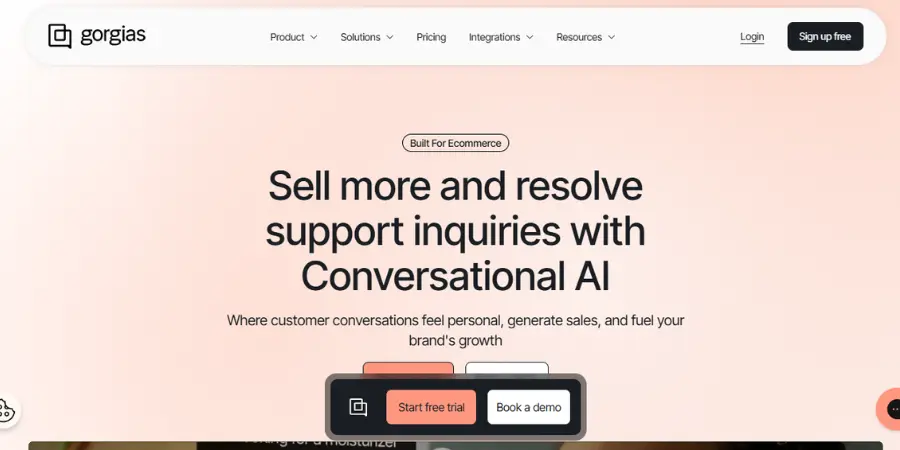
Gorgias is a cloud-based helpdesk built exclusively for ecommerce brands. It pulls your store data and your customer conversations into one place, so support agents never have to leave the dashboard to check an order, issue a refund, or update a shipping address.
It connects directly with Shopify, Magento, BigCommerce, and WooCommerce, and centralizes conversations from email, live chat, SMS, WhatsApp, Facebook, Instagram, and TikTok into one console.
The platform is trusted by over 15,000 brands and combines a helpdesk foundation with a conversational AI layer built to support, sell, and re-engage shoppers at scale.
That combination order context plus omnichannel inbox plus automation is what separates it from generic helpdesk tools. A customer messages about a late delivery and the agent already sees the order number, carrier, and fulfillment status without asking a single follow-up question.
 Ecommerce Teams Are Moving Toward It
Traditional helpdesks were built for IT departments and SaaS companies. They handle tickets cleanly but know nothing about SKUs, return windows, or fulfillment pipelines. For an online store, that gap creates constant operational friction.
Brands using Gorgias have reported 90% faster response times, 5% fewer returns, and measurably improved customer satisfaction.
At low ticket volumes, that efficiency is a nice-to-have. At 1,000+ tickets per week, it becomes the difference between a two-person support team and a five-person one. That's the core value proposition not just better tooling, but a smaller headcount requirement to maintain the same response quality.
Core Features That Actually Move the Needle
1. Order-Aware Unified Inbox
Every conversation arrives with context attached. The dashboard provides quick access to past orders, reviews, subscriptions, and previous support interactions, helping agents quickly plan for an optimal outcome.
In practice, this means a return request doesn't require three minutes of digging. The agent sees everything relevant in one glance and resolves it in one reply.
2. Macros, Rules, and Automation
Gorgias automation cuts repetitive inquiries and provides round-the-clock support when the team is offline. Businesses can create custom automation rules to auto-assign tickets to specific agents or teams.
A real example: a rule detects the phrase "where is my order," tags it as a WISMO ticket, pulls the tracking link directly from Shopify, and sends an automated reply all before a human touches it. For high-volume stores, a single well-built rule like this can resolve 30–40% of daily tickets automatically.
3. Revenue Tracking Built Into Support
This is the feature that changes internal conversations at growing brands. Gorgias tracks how much revenue comes from support interactions. If a customer makes a purchase after chatting with an agent, it shows in the analytics highlighting which agents drive the most sales and which support channels convert best.
For teams trying to justify headcount or prove the ROI of investing in customer experience, this data is genuinely useful.
4. The AI Agent
Gorgias AI Agent 2.0 made a significant strategic shift instead of just handling common support questions, it's now built to drive revenue by turning support chat into an active sales channel.
It operates in two modes. Before a purchase, it acts as a Shopping Assistant suggesting products, answering sizing or compatibility questions, and offering discounts to nudge conversions. After a purchase, it handles order tracking, return requests, and FAQ resolution autonomously.
You can teach it your brand voice, policies, and workflows so it responds exactly like your team and it can take real actions like editing orders or processing returns without human involvement.
How It Compares to Traditional Tools
Feature | Gorgias | Traditional Helpdesk |
|---|---|---|
Ecommerce Integration | Native (Shopify, WooCommerce) | Limited or third-party |
Order Management | Built-in | Requires switching tools |
Pricing Model | Per ticket volume | Per agent seat |
AI Automation | Ecommerce-native | General purpose |
Best For | DTC and Shopify brands | Broad industry use |
Revenue Tracking | Yes | Rarely included |
The Pricing Structure Nobody Explains Clearly
This is where most Gorgias articles stop being useful. The pricing has layers that interact in ways that aren't obvious until you're mid-growth.
Ticket-Based Billing, Not Agent-Based
Gorgias uses a ticket-based model, not per-agent pricing. Plans range from $10/month on the Starter tier to $900/month on the Advanced tier, with unlimited agent seats included on all paid plans.
Adding more team members costs nothing extra. But your bill grows every time your ticket count grows which means a viral product launch, a shipping delay, or a seasonal campaign can spike your monthly cost overnight with no warning.
The Double-Billing Problem
This is the part most teams discover too late. AI Agent tickets are double-billed you pay for both the helpdesk ticket and the automation fee, which runs $0.90–$1.00 per conversation.
A brand automating 1,200 support inquiries monthly pays roughly $1,080 in AI fees alone, on top of the base plan cost. That is not a marginal add-on. For a store on the Pro plan at $360/month, enabling AI automation can nearly double the actual monthly spend before you notice.
A Shopify brand on the Pro plan automating 30% of its 2,000 monthly tickets ends up paying roughly $720/month close to twice the advertised plan price.
Voice and SMS Are Separate Add-Ons
Neither is included in any standard plan. A growing store handling around 400 voice and 250 SMS tickets per month would pay approximately $310 in add-ons alone, on top of their main plan and AI costs.
The practical advice: before committing to any plan, map your actual ticket mix across all channels and run the numbers based on where you'll realistically be in six months not where you are today.
Read Also: Adobe Podcast: Features, Uses & Tips
The AI Limitations Most Reviews Skip
It only works with Shopify. Brands on WooCommerce, Magento, or Salesforce Commerce Cloud cannot use Gorgias AI automation at all. If you're not on Shopify, the AI features are essentially unavailable regardless of which plan you're on.
It can hallucinate. Gorgias has acknowledged that their AI can invent product features or generate fake discount codes. For brands selling technical products, high-ticket items, or anything where response accuracy is non-negotiable, human review of AI outputs is still necessary.
The automation rate is often overstated. Gorgias markets 60% automation, but real-world case studies show figures closer to 26–56% depending on the brand's ticket mix and how thoroughly the AI has been trained on accurate knowledge sources.
Who Should Actually Use Gorgias
It makes strong sense if you:
Run a Shopify store with 300+ monthly tickets
Want order management and support in one place
Need multichannel coverage without managing separate tools
Want to track revenue generated from support interactions
It makes less sense if you:
Are on WooCommerce or Magento and want AI features
Have unpredictable seasonal spikes that make ticket-based billing risky
Are a small store under 100 tickets per month where the cost-to-value ratio doesn't work
Need advanced analytics out of the box managers frequently report that the analytics feel too technical for frontline teams
Common Mistakes Teams Make
Deploying AI before training it properly. The AI learns from your help center, product catalog, and policy documents. Launching it before those sources are accurate and complete is the fastest way to generate wrong responses at scale.
Choosing a plan based on current volume. The ticket model punishes growth. A team comfortably within their Basic plan limits today can hit overage charges within two months if the business picks up. Sizing up one tier in advance is almost always cheaper than paying overage rates reactively.
Ignoring add-on costs during budgeting. Voice, SMS, and AI automation fees are easy to overlook during a free trial. They show up clearly and quickly once you're in production with real ticket volumes.
Over-relying on automation without reviewing outputs. Even well-trained automation makes mistakes. A monthly audit of automated responses catches errors before they become a customer experience problem.
Expert Tips
Run short samples before going live. Before enabling any automation rule on live tickets, test it on a sample of past conversations. Different ticket types respond differently to the same rule logic, and catching edge cases before launch saves a lot of cleanup.
Build your WISMO automation first. "Where is my order" queries typically represent 30–40% of ecommerce support volume. Automating this single intent before anything else delivers the fastest visible reduction in manual workload.
Pair it with basic inbox hygiene. Macros and rules perform better when your ticket views are clean and well-organized. Spending time upfront on view structure and tagging taxonomy makes every automation you build afterward more effective.
Model your six-month cost, not your current cost. The ticket-based pricing model is friendly at low volume and expensive at high volume. Build a simple spreadsheet projecting your ticket growth and the impact on your monthly bill before signing an annual plan.
When Should You NOT Use Gorgias?
If you're not on Shopify, the AI features won't be available to you which removes a significant part of the value proposition. If your ticket volume is low and predictable, a simpler per-agent tool will likely cost less and require less configuration overhead. And if you need deep reporting and SLA tracking without technical setup, the analytics layer will feel limiting without significant time investment.
Is Gorgias Worth It?
For the right store, absolutely. For established Shopify brands with steady ticket volume, Gorgias delivers powerful automation with genuinely useful ecommerce features the deep integration, dual AI personas, and revenue tracking are all well-executed.
The honest caveat is the pricing model. It rewards consistency and punishes volatility. A brand with stable, predictable support volume will find it cost-efficient and operationally excellent. A brand with seasonal spikes or aggressive growth curves needs to model the numbers carefully before committing because the costs scale in the same moments your business is succeeding.
That's not a flaw in the product. It's just the part most reviews forget to say out loud.
Summary
Gorgias is an ecommerce-native helpdesk that brings order data, customer conversations, and AI automation together in one place. Its deep Shopify integration, unified inbox, and revenue tracking make it one of the most capable support tools available for online brands. The pricing model ticket-based with double-billing for AI automation and separate add-ons for voice and SMS creates costs that grow faster than many teams expect. For Shopify brands with consistent volume, it delivers strong ROI. For everyone else, the platform limitations and pricing structure deserve careful evaluation before committing.
Frequently Asked Questions
Can Gorgias be used without Shopify?
Yes for core helpdesk features, but the AI Agent and most advanced automations are Shopify-exclusive. Non-Shopify brands get a noticeably smaller feature set.
Why does Gorgias charge twice for AI tickets?
Each AI-resolved conversation counts as both a helpdesk ticket and an automated resolution, so you're billed under both pricing layers simultaneously.
What's a realistic monthly cost for a mid-sized store?
A Pro plan brand using AI automation for 30% of tickets should budget $700–$750/month nearly double the advertised $360 base price.
Does Gorgias actually automate 60% of tickets?
Real-world figures range from 26–56% depending on ticket mix and how well the AI has been trained. The 60% figure reflects best-case conditions.
Is Gorgias suitable for non-ecommerce businesses?
It can work, but it's specifically optimized for online retail workflows. Businesses outside ecommerce will find better value in general-purpose helpdesks built for their industry.