
Ask a room of project managers what wrecks a timeline and you'll get the same list every time. Scope creep. Bad estimates. Resource conflicts. A vendor who missed a date. All of those are real, and all of them are worth guarding against.
But sit through enough post-mortems and a less flattering pattern shows up. The schedule was fine. The problem was that information about the schedule never reached the people who needed it, in a form they could act on, at the moment it mattered. Project communication problems do not look like failures in a Gantt chart, which is exactly why they keep getting misdiagnosed as something else.
I want to unpack why that happens, and what I'd actually change about it.
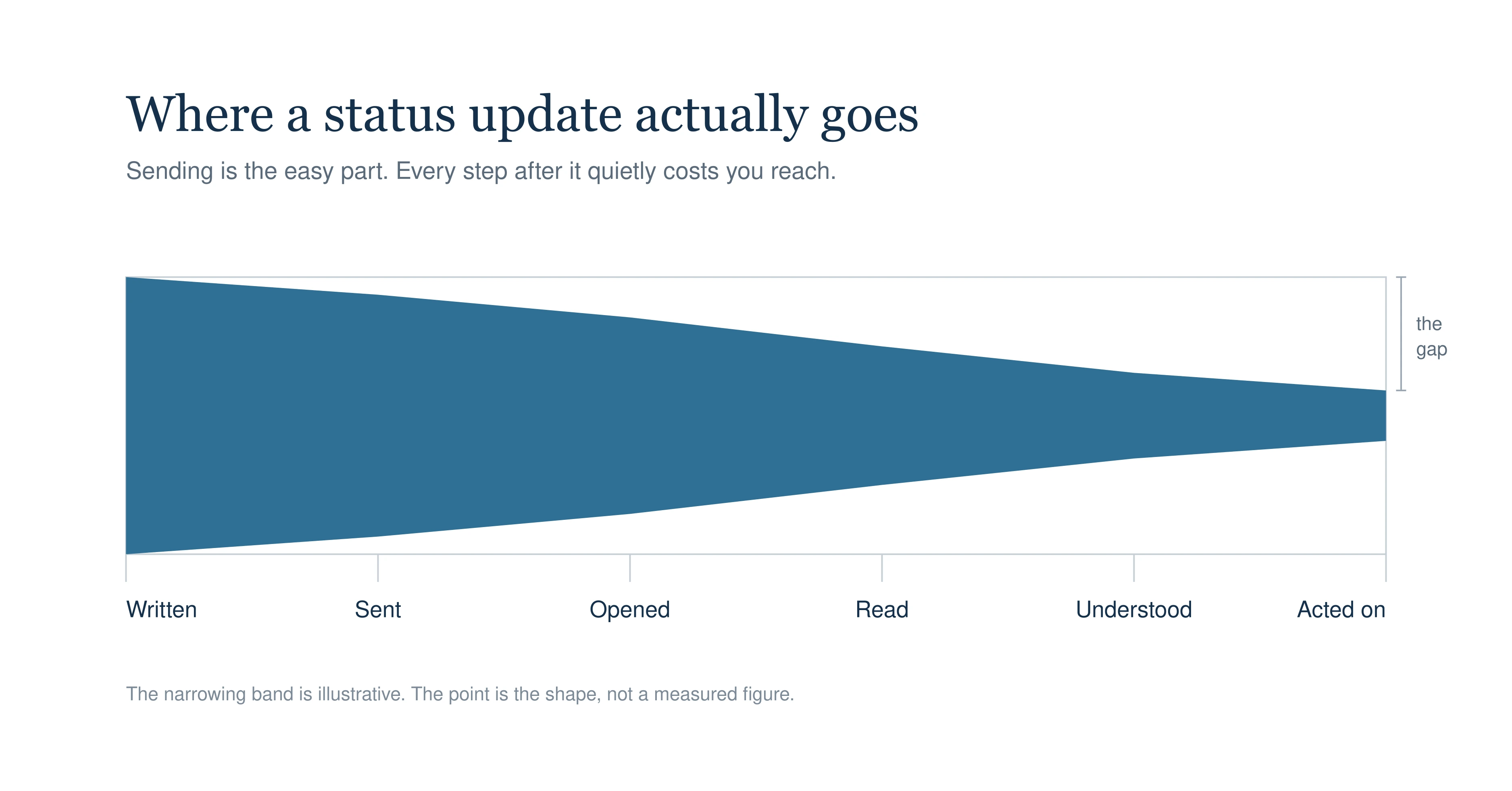 The Gap Between "We Sent It" and "They Understood It"
Every PM has said some version of "we communicated that" in a post-mortem. And most of us have been technically right and practically wrong at the same time.
An email went out. A Slack message got posted. A line item showed up in a status report nobody opened past the subject line. Information left someone's hands, so in the narrow sense, communication happened.
It didn't happen in the sense that counts, which is information landing somewhere a decision could be made from it.
That gap is where a huge share of preventable delays actually live. A sponsor who doesn't know a risk moved from "possible" to "likely" can't help you mitigate it. A dependent team that never heard the upstream task slipped keeps planning against a date that's already gone.
None of that registers as a scheduling failure in your tool. It registers as a surprise three weeks later, over something that could have been a fifteen minute conversation on a Tuesday.
Why Project Communication Problems Hide Inside Healthy-Looking Plans
Here's what makes this category so hard to catch early. A missed dependency is easy to diagnose after the fact. You can point at the task, the date, the resource that wasn't available. It's concrete, and it leaves a trace in the tool.
A communication failure leaves almost no trace. It looks like a status update that got sent but not read. A risk that got mentioned once in a meeting nobody minuted. A stakeholder who found out about a slip two weeks after the delivery team already knew.
None of those show up on a burndown chart. The plan looks healthy right up until it doesn't.
I think this is why the category stays underrated. Project management training is heavy on artifacts, risk registers, RAID logs, dependency maps, and light on the question of whether anyone is actually reading them. We measure whether the artifact exists. We rarely measure whether it landed.
The First Thing I'd Expect to Slip
If I had to name the single most reliable early warning sign, it's this: status reporting is almost always the first thing to degrade when a PM gets busy, and it degrades exactly when it's needed most.
Early in a project, when things are calm, the updates are good. Clear risk sections. Honest RAG statuses. Enough context that someone who wasn't in the room can follow along.
Six weeks in, under real pressure, that same report becomes three bullets typed in a hurry between two meetings.
I don't read that as a discipline failure. It's a resource allocation problem, which is the same kind of problem PMs are trained to solve everywhere except in their own calendars.
Writing an update that's actually clear takes real drafting effort. Explaining why something is red rather than just flagging that it is. Giving a sponsor enough context to ask a useful follow-up question instead of a panicked one. Deciding how bluntly to phrase a risk without either burying it or setting off alarms.
That work costs time. And under deadline pressure, that time loses to whatever task has the angriest stakeholder attached to it. Every single time.
Where a Writing Tool Actually Helps
This is one place where the mechanical half of the job has genuinely gotten cheaper to offload.
Turning a rough pile of updates, risks, and blockers into a structured, readable first draft is exactly the kind of task an AI writing tool handles well. Something like Writecream can take that raw list and produce an organized draft in a few minutes, which leaves the PM editing for accuracy and tone rather than staring at a blank page with eleven minutes before the next call.
I want to be careful about what that does and doesn't solve, though.
The judgment stays with the PM. Deciding what's genuinely worth flagging, how directly to phrase a risk, which stakeholder needs three paragraphs of context and which one needs two lines, none of that gets outsourced. A drafting tool that's fed a vague or dishonest set of inputs produces a polished, vague, dishonest report. That's arguably worse than three rushed bullets, because it looks like diligence.
What it does solve is the blank page problem. The drafting step is the one most likely to get skipped entirely when time is short, and making it cheap means it stops being the first casualty.
Cadence Is a Different Problem From Clarity
There's a second failure that has nothing to do with how good any individual update is.
A team that gets a sharp, useful report in week one and then nothing in week two isn't just missing one update. It's teaching stakeholders not to trust the next one, because the rhythm itself has become unreliable. People stop reading a channel that only sometimes has something in it.
Consistency and quality are genuinely different problems, and they get solved differently.
A single excellent report written once is a writing problem. A reliable weekly report going to the right five people, on the right day, in the right shape for each channel, a short version for Slack, a fuller one for email, a summary slide for the steering committee, is a logistics problem.
That's repetitive, format-specific work. It never feels urgent in the moment you're neglecting it, which is precisely why it slides.
The channel matters here too. A lot of teams already have most of what they need sitting inside their existing collaboration software, and the problem isn't a missing tool so much as nobody having decided which channel the weekly update actually lives in.
A Note on Scheduling Automation
I'd normally point to scheduling automation here, and this is where I want to be straight with you rather than tidy.
The principle is sound. Protecting the cadence with something more reliable than a PM's memory during a busy sprint is a real idea, and the underlying pattern, getting the right version of the same core information to different audiences on a fixed schedule without someone manually reformatting it every week, is structurally similar across a lot of domains.
But most of the tools built for that pattern are built for social media. SchedulifyX, for example, is a solid AI-driven scheduler across roughly ten social platforms, with client portals and white-label options that make it a genuinely good fit for agencies managing content calendars. It is not built for routing a RAG status report to a steering committee, and I'm not going to pretend otherwise.
If your work sits at the overlap, say you're an agency PM who also owns client-facing content, then a tool in that category earns its place in your stack for the content half of the job. For internal stakeholder updates specifically, you're better served by a recurring calendar block, a saved template, and a distribution list, or by whatever automation already lives inside your PM tool.
The principle is worth taking seriously. The tool category has to actually match the job.
What I'd Change on a Real Project
Stripping out the tooling question entirely, here's where I'd put the effort:
Treat the update as a deliverable with its own deadline. Not something that happens automatically if the work underneath is going well, but a line item with time protected around it.
Separate "sent" from "landed." Build in one lightweight confirmation step for anything material, a reply, a thumbs up, a two minute call. If a risk changes status and nobody acknowledges it, assume it didn't land.
Write the risk section first, not last. It's the part that gets cut when time runs out, and it's the only part that prevents surprises.
Match the format to the reader. A sponsor doesn't need the same document your delivery team gets. Sending one version to everyone means most recipients skim past the part meant for them.
Protect the rhythm above the polish. A consistently decent weekly update beats an occasional excellent one, because trust in the channel is what makes people read it at all.
The Underlying Point
None of this is really about writing tools or scheduling tools.
It's about noticing that "we sent the update" and "the right person understood it in time to act" are two different claims, and most post-mortems quietly treat them as one.
A slip that's communicated clearly, early, to the right people is manageable. Sponsors adjust. Dependent teams replan. Nobody gets blindsided.
The exact same slip, found late because the update that would have flagged it got compressed into an unreadable bullet or skipped that week, turns into a crisis.
The PMs I'd bet on aren't the ones with the most elaborate risk registers. They're the ones who treat communication clarity and cadence as critical path items, with the same seriousness they'd give any other dependency.
Projects rarely fail because the work was impossible. They fail because someone didn't know something in time to do anything about it, and that gap is almost always closeable if you treat it as a real risk instead of an afterthought.
Frequently Asked Questions
What are the most common project communication problems?
The ones I see most are updates that get sent but never read, risks mentioned verbally and never written down, stakeholders finding out about a slip long after the delivery team knew, and status reports that degrade into a few rushed bullets under deadline pressure.
How do communication problems cause project delays if the schedule is accurate?
The schedule can be perfectly accurate and still fail if the people who need to act on it don't get the information in time. A dependent team planning against a date that already moved will miss it, and that shows up as a delay even though the plan was correct when it was written.
Why does status reporting get worse as a project gets busier?
Writing a genuinely useful update takes real thinking time, and thinking time is the first thing sacrificed when a PM is under pressure. The irony is that reporting quality drops exactly when the project most needs visibility.
Can AI writing tools fix project communication problems?
Only partly. They handle the mechanical drafting step, which helps because that's the step most likely to be skipped. They can't decide what's worth flagging or how honestly to phrase a risk, and a polished report built on vague inputs can do more harm than a rushed but honest one.
Is scheduling automation useful for stakeholder updates?
The principle is useful, but most scheduling tools are built for social media rather than internal reporting. For stakeholder updates I'd use a recurring calendar block, a saved template, and whatever automation already exists inside your project management tool.
How often should project status updates go out?
Weekly works for most projects, but the specific interval matters less than keeping it consistent. An unreliable cadence trains people to stop checking the channel, which undoes the value of any individual update.
What's the difference between clear communication and consistent communication?
Clarity is about whether a single update can be understood and acted on. Consistency is about whether people trust the channel enough to read it at all. They're separate problems, and fixing one doesn't fix the other.