
If you are searching for "SEOmoz tools," there is a good chance you are using a name that officially retired years ago, and that is worth knowing before you go looking for a product called SEOmoz, because you will not find one.
SEOmoz is the original name of the company now simply called Moz.
The tools people mean by "SEOmoz tools" are today's Moz and Moz Pro toolkit. So this guide does two things: it clears up the SEOmoz-to-Moz story, then walks through what the current tools actually are, what they cost, and who they suit.
No fluff, no outdated screenshots of a brand that no longer exists. Just what the SEOmoz name points to now and whether it is worth your money.
What Is SEOmoz?
A little history makes everything after it click.
SEOmoz was founded in 2004 by Rand Fishkin and Gillian Muessig, starting life as a blog and community where early search-optimization practitioners shared research and ideas.
It grew into one of the most influential names in the SEO world, and in time it built software to go with the community.
In 2013 the company shortened its name to simply Moz, dropping the "SEO" prefix as it broadened beyond pure search.
The old SEOmoz brand stuck in people's memories and search habits, though, which is exactly why "SEOmoz tools" is still typed into search bars today.
So when you see SEOmoz, read it as Moz. Same lineage, current name, and a toolkit that has evolved a long way from those early days.
What Are SEOmoz Tools?
With the name settled, here is what the tools actually do.
SEOmoz tools, meaning Moz's tools, are an all-in-one SEO software suite built to help people improve their visibility in search engines.
The suite covers the core jobs of SEO: researching keywords, analyzing backlinks, tracking rankings, auditing a site for technical problems, and studying competitors, all organized around campaigns for the sites you manage.
The paid suite is called Moz Pro, and it is the heart of the offering.
Around it sit a few companions: MozBar, a free browser extension for quick metrics; Moz Local, for local search and business listings; and a set of free tools anyone can use without paying.
Moz's whole philosophy is to make SEO approachable, so the tools lean toward clarity and guidance rather than drowning you in raw data. That focus is a big part of who they suit, which we will come back to.
 The Moz Pro Toolset, Tool by Tool
Here is the core of what you are paying for, the individual tools inside Moz Pro and what each one is for.
Keyword Explorer is the centerpiece. You enter a keyword and it returns search volume, difficulty, and a priority score blending those with click-through potential.
That lets you judge which terms are worth chasing, and it now adds AI-powered suggestions on top.
Link Explorer analyzes backlinks, yours or a competitor's, showing who links to a site, the quality of those links, and the all-important Domain Authority score. It is Moz's answer to backlink research.
Rank Tracker monitors where your target keywords sit in search results over time, so you can see whether your work is moving the needle. On Moz Pro this updates weekly.
Site Crawl audits your website for technical problems, broken links, duplicate content, missing meta tags, and other issues that can quietly hurt rankings, and flags them for fixing.
On-Page Grader checks individual pages against a target keyword and suggests concrete on-page improvements.
Competitive Research and Domain Overview size up rival sites, their authority, keywords, and gaps, so you can see where you stand and where the openings are.
Together these cover the full SEO workflow, from finding keywords to fixing your site to watching your rank.
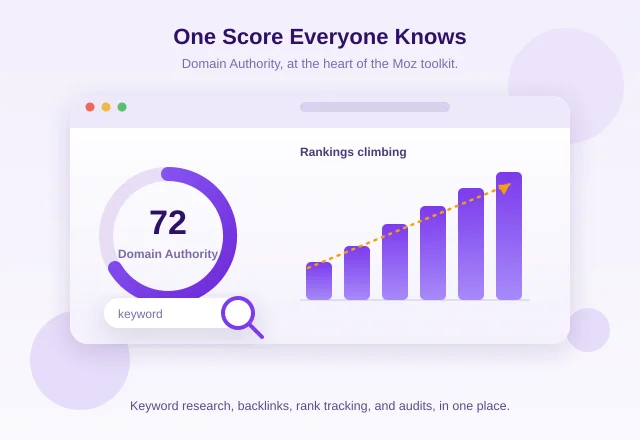
What Is Domain Authority? Moz's Signature Metric
One Moz invention deserves its own section, because you have almost certainly heard of it.
Domain Authority, or DA, is a score from 1 to 100 that Moz created to predict how likely a website is to rank in search results.
A higher DA suggests a stronger site. It has become an industry shorthand, used in agency reports, PR outreach, and link evaluations across the whole marketing world, and Moz is the only platform that calculates it natively.
One honest caveat matters here: DA is Moz's own metric, not something Google uses to rank pages. It is a useful comparative benchmark, is this site stronger than that one, but it is not a direct measure of Google's actual ranking decisions.
Treat it as a helpful gauge, not gospel.
That nuance aside, DA's industry-wide adoption is a real reason Moz stays relevant, when someone says "our DA is 52," everyone in marketing knows what they mean.
Free SEOmoz Tools You Can Use Today
Not everything requires a subscription, which is part of Moz's appeal.
A free Moz Community account gives you limited access to Keyword Explorer and Link Explorer, enough to run occasional checks without paying.
MozBar, the browser extension, shows Domain Authority and other metrics for any page as you browse, a favorite even among people who use other paid tools.
These free tools are truly useful on their own, and they are a low-risk way to get a feel for how Moz works before deciding whether the paid suite is worth it.
Moz Pro Pricing
Cost is usually the deciding question, so here is the current shape of it.
Moz Pro is sold in tiers, billed monthly or, more cheaply, annually.
As of 2026 the plans run roughly like this on annual billing: Starter around $39 a month, Standard around $79, Medium around $143, and Large around $239, with an Enterprise tier by custom quote.
Monthly billing costs more, with Standard near $99, for example.
Higher tiers raise the limits, more keywords tracked, more pages crawled, more campaigns, and unlock deeper features. Moz Local, for business listings and reviews, is priced separately and starts low, around $14 to $16 per location per month.
For exact current numbers and what each tier includes, it is worth checking Moz's own pricing, since plans and limits shift over time.
Pricing tiers that shift over time aren't unique to SEO software either. Our breakdown of Uplearn's pricing covers a similar plans-and-value analysis for an education platform, a completely different category, but the same kind of question: what you actually get at each price point.
As a rough guide, small businesses and solo SEOs tend to land on Starter or Standard, while agencies climb higher.
Pros and Cons of SEOmoz Tools
A balanced view before you commit.
The strengths:
Beginner-friendly design and outstanding educational resources, the Moz blog and Academy are widely respected
Domain Authority, an industry-standard benchmark you cannot get natively anywhere else
A generous free tier plus the free MozBar extension
Strong, affordable local SEO through Moz Local
Clear, campaign-based workflow that gets newcomers productive quickly
The trade-offs:
A smaller backlink index than Ahrefs, which matters for deep link research
A narrower feature set than Semrush, no PPC, social, or content-marketing suites
Rank tracking updates weekly on Moz Pro, not daily, unless you add the separate STAT product
Site Crawl is less powerful than dedicated technical tools for very complex audits
Who Should Use SEOmoz Tools?
The fit is fairly specific, and naming it saves you a mismatch.
Moz suits beginners and small-to-mid-sized businesses who want approachable, well-taught SEO without the firehose of data, and the price to match.
It suits agencies serving local clients especially well, thanks to Moz Local and the DA metric that clients recognize.
And it suits anyone who values Domain Authority as a reporting benchmark.
It is a weaker fit for power users and large agencies who need the deepest backlink data, daily rank tracking, or an all-in-one marketing suite spanning paid and social. Those users often lean toward Ahrefs or Semrush instead.
SEOmoz vs Semrush
The usual first comparison, so here is the short version.
Semrush is the broader, heavier platform: it spans SEO, PPC, content marketing, and social in one sprawling suite, with a larger dataset, and it costs more.
Moz is the focused, friendlier, more affordable option centered on core SEO and its education-first approach.
If you want one tool to run every channel and have the budget, Semrush casts a wider net. If you want approachable core SEO, Domain Authority, and gentler pricing, Moz makes the stronger case.
SEOmoz vs Ahrefs
The other big comparison comes down largely to data depth.
Ahrefs is renowned for its huge backlink index and powerful site audit, the tool of choice for serious link builders and technical SEOs who want maximum data.
Moz counters with usability, education, the DA metric, and lower entry pricing, but a smaller link database.
For heavy backlink and technical work, Ahrefs generally wins on raw capability, and our look at the Ahrefs mobile app covers one practical limitation of it. For friendlier, budget-conscious SEO with a recognized authority metric, Moz holds its own.
SEOmoz Alternatives
Beyond the big two, a few names round out the field.
The main alternatives to Moz are Semrush and Ahrefs, the two heavyweights already covered. Beyond them, tools like Ubersuggest offer a cheaper, lighter option, while Screaming Frog is a specialist for deep technical site crawling.
SE Ranking and Mangools are also popular mid-market picks that balance features and price.
Which alternative fits depends on your priority: budget, data depth, breadth of channels, or technical crawling.
Choosing well is the same disciplined evaluation that applies to any tool, the kind we walk through in what works in digital marketing.
Frequently Asked Questions
What is SEOmoz?
SEOmoz is the original name of the SEO company now called Moz, founded in 2004 by Rand Fishkin. It rebranded to Moz in 2013, so "SEOmoz tools" means today's Moz tools.
Is SEOmoz the same as Moz?
Yes. SEOmoz shortened its name to Moz in 2013. They are the same company, and its current SEO software is called Moz Pro.
What are SEOmoz tools?
They are Moz's SEO tools: Keyword Explorer, Link Explorer, Rank Tracker, Site Crawl, On-Page Grader, and competitive research, plus MozBar and Moz Local, mostly bundled in Moz Pro.
What is Moz Keyword Explorer?
It is Moz's keyword research tool. It shows search volume, keyword difficulty, and a priority score, with AI-powered suggestions, to help you choose which keywords to target.
What is Domain Authority in Moz?
Domain Authority is a 1-to-100 score Moz created to predict a site's ranking strength. It is an industry benchmark, though it is Moz's own metric, not a Google ranking factor.
How much does Moz Pro cost?
On 2026 annual billing, Moz Pro runs roughly from about $39 a month for Starter up to about $239 for Large, with a custom Enterprise tier. Monthly billing costs more.
Is Moz Pro worth it?
For beginners, small businesses, and local agencies who value ease of use and Domain Authority, yes. Power users needing the deepest data often prefer Ahrefs or Semrush.
What are the best SEOmoz alternatives?
The main alternatives are Semrush and Ahrefs, the two heavyweights. Ubersuggest, Screaming Frog, SE Ranking, and Mangools are also worth considering depending on your needs.
The Bottom Line
SEOmoz tools are simply Moz tools by an older name.
The company that began as SEOmoz in 2004 became Moz in 2013, and its modern toolkit, Moz Pro, covers keyword research, backlinks, rank tracking, site audits, and competitive analysis, anchored by the industry-famous Domain Authority metric.
Moz's real strength is not raw data volume; it is approachability, education, and a recognized authority score, at a friendlier price than Ahrefs or Semrush.
That makes it a strong pick for beginners, small businesses, and local agencies, and a weaker one for power users chasing the deepest datasets.
If the SEOmoz name led you here, now you know where it points, and whether the tools behind it fit how you actually work.