
A friend's sister spent weeks comparing revision platforms before her A-Levels, and the detail that actually convinced her to commit wasn't the video lessons or the quizzes. It was a specific written guarantee: A* or A, or your money back. That's the kind of claim worth verifying properly before you take it at face value, so I did.
Here's the accurate, current picture of what UpLearn actually offers, what it costs, and whether that guarantee holds up.
What UpLearn Actually Is
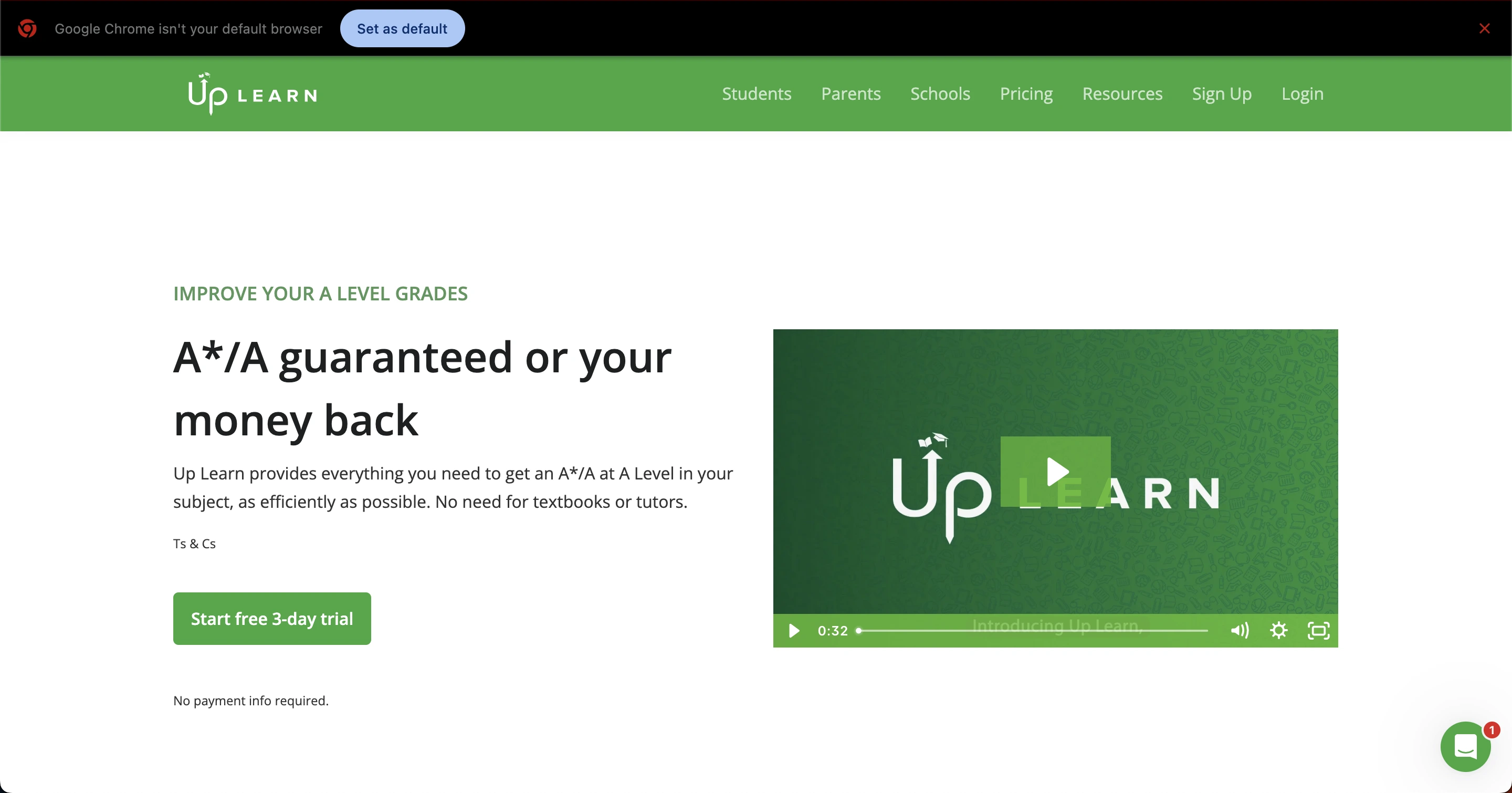
UpLearn, officially branded as Up Learn, is an online learning platform designed primarily for A-Level and GCSE students, using AI and neuroscience-based methods with a genuinely notable claim behind it, an A* or A grade guarantee, or your money back, regardless of a student's starting point.
That guarantee isn't buried marketing language. It's stated directly on the platform's own pricing page as a core commitment, and it's the single biggest thing separating this platform from generic revision sites that just offer video lessons and hope for the best.
The Actual Subjects Covered
Current coverage spans A Level Biology, Chemistry, Physics, Maths, Economics, and Psychology, plus GCSE Combined Science, with exam-board specific content built for AQA, Edexcel, OCR, and Cambridge International.
That's a broader range than some descriptions of the platform suggest, particularly since Chemistry, Physics, and Maths are genuinely core to what UpLearn covers, not peripheral additions. If you're checking whether your specific subject is included, verify against this full list rather than an incomplete summary.
How UpLearn Actually Works
The learning approach follows a consistent structure. Students choose their subject and exam board, then work through short, focused video lessons covering one concept at a time. Each lesson is followed by quizzes testing understanding immediately, progress tracks in real time, and weak areas get identified automatically rather than requiring the student to guess where they're falling behind.
This structure is deliberately built around active recall rather than passive video watching, which is exactly the learning method most consistently supported by actual exam performance research, not just a marketing buzzword.
The Real Pricing You Need to Know
Here's where I want to correct the vague "pricing varies" framing that shows up in a lot of coverage. Current pricing runs £419.99 for full access to a single subject through 31 July 2027, or £694.98 for a tier that adds unlimited one-to-one tutor support plus two exam papers officially marked by real examiners, valid through 31 July 2028.
Both tiers include the A*/A guarantee. If your plan expires before you finish, your progress and guarantee eligibility are both preserved, so renewing later picks up exactly where you left off. Worth knowing separately, a scholarship programme exists for eligible students offering free access in certain circumstances, genuinely worth checking directly if cost is a real barrier.
 The Tutor Support Detail Most Reviews Undersell
Selected plans include access to tutor support, but the specific detail worth knowing is who's actually providing it. Students get access to both AI tutors and human tutors from institutions including Oxford, Cambridge, LSE, and Imperial, available 24/7 rather than during limited office hours.
That's a genuinely different offering from a generic "ask a question" chat box. Having access to tutors from those specific institutions around the clock is a real differentiator worth factoring into whether the higher pricing tier justifies itself for your situation.
Key Features Beyond Video Lessons
Exam board-specific content maps every lesson directly to official specifications, eliminating unnecessary material that never actually appears on the real exam. Smart quizzes reinforce learning immediately after each lesson rather than delaying assessment until a separate revision session.
Performance tracking dashboards show topics completed, accuracy levels, study time, and weak areas in one view. The confidence prediction system uses quiz performance and learning patterns to estimate exam readiness, useful for motivation and honest self-assessment, though it's worth treating as a directional signal rather than a guaranteed prediction of your actual exam result.
Who Should Actually Use This
UpLearn works best for A-Level and GCSE students who want structured, guided revision rather than building their own study plan from scratch. It particularly suits learners who struggle with time management or self-planning, since the platform directs exactly what to study next rather than leaving that decision entirely up to the student.
Who Should Look Elsewhere
Casual learners or students outside the UK exam system genuinely won't get value here, since content is built specifically around GCSE and A-Level specifications. If your primary need is general subject exploration rather than exam-specific preparation, a broader learning platform serves that goal better. And if £419.99 to £694.98 per subject is genuinely outside your budget with no scholarship eligibility, that's worth weighing seriously against the platform's real value before committing.
UpLearn vs Traditional Tuition
Factor | UpLearn | Traditional Tuition |
|---|---|---|
Cost | £419.99 to £694.98 per subject | Usually higher, ongoing hourly fees |
Availability | 24/7 online access | Limited to scheduled sessions |
Pace | Fully self-paced | Depends on tutor's schedule |
Content focus | Exam-board specific throughout | Depends entirely on individual tutor |
Progress tracking | Automatic dashboard | Depends on tutor's own feedback habits |
Interaction | AI tutors plus human tutors from top universities | One-to-one with a single tutor |
Guarantee | A*/A or money back | No standard guarantee exists |
Many students genuinely use UpLearn alongside tutoring rather than as a full replacement, particularly for subjects where they need more personalized explanation than even a strong AI and video-based system can provide.
Study Tips for Actually Getting Value From It
Set a realistic, consistent study schedule, even just 30 to 45 minutes daily beats irregular longer sessions. Always complete quizzes honestly rather than guessing, since they're specifically designed to test real understanding and surface gaps you'd otherwise miss.
Focus deliberately on weak areas the dashboard highlights rather than reviewing topics you're already comfortable with, since that targeted approach is where the platform's real efficiency advantage lives. And use it alongside school learning rather than as a complete substitute, reinforcing classroom material rather than replacing it entirely.
Safety, Privacy, and Device Compatibility
UpLearn follows standard UK data protection practices and is used widely by students and schools across the country. Personal progress data stays private and accessible only to the user. The platform works across desktops, laptops, tablets, and smartphones, with lessons and progress syncing automatically across devices, though a stable internet connection is required for video and quiz functionality.
Verifying Exam Board Alignment Directly
Since UpLearn's core value proposition depends entirely on genuine alignment with official exam specifications, it's worth understanding how that alignment actually gets regulated in the UK. Ofqual, England's official qualifications regulator, oversees exam board standards directly, and cross-checking any platform's claimed alignment against official exam board specifications yourself remains good practice regardless of how confidently any platform, including this one, describes its own content mapping.
Comparing This to Other Learning Platforms
If you're evaluating structured, subject-specific learning platforms more broadly rather than just this one, it's worth seeing how a comparable platform handles curriculum-specific content for younger students. Our coverage of Generation Genius covers a K-8 science platform with a similarly structured, standards-aligned approach, useful comparison if you're thinking about education technology across different age groups within the same household.
Is UpLearn Actually Worth It
Whether it's worth the price depends genuinely on your learning style and how seriously you engage with it. Students who prefer structured guidance and consistently complete lessons and quizzes report noticeable improvement in exam confidence and understanding. Students expecting motivation without putting in consistent effort are unlikely to see the results the A*/A guarantee implies, since that guarantee comes with real conditions attached, not automatic success from simply having an account.
Final Verdict
UpLearn is a genuinely solid choice for exam-focused students who want structure, clarity, and a real grade guarantee backing that structure up. The current pricing sits meaningfully higher than vague online summaries suggest, so budget for £419.99 to £694.98 per subject realistically, and check the scholarship programme directly if cost is a genuine concern.
It doesn't promise shortcuts, and it requires actual consistent effort to get value from. But for A-Level and GCSE students specifically who want guided revision with real institutional tutor access behind it, it's worth serious consideration.
FAQs
Is UpLearn good for A-Level students?
Yes, it's built specifically for A-Level students with content mapped directly to exam board specifications across six core subjects.
Does UpLearn actually guarantee a grade?
Yes, an A* or A grade guarantee, or money back, is included on paid plans, a genuine differentiator most competing platforms don't offer.
How much does UpLearn actually cost?
Current pricing runs £419.99 to £694.98 per subject depending on the tier, with a scholarship programme available for eligible students.
Can UpLearn replace a tutor entirely?
It can support learning significantly, including access to human tutors from Oxford, Cambridge, LSE, and Imperial, though many students use it alongside traditional tutoring rather than as a full replacement.
Is UpLearn suitable for students outside the UK?
Not really, since content is built specifically around GCSE and A-Level UK exam board specifications.