
The quickest way to understand Anthropic technology is this: one company builds one family of AI models, called Claude, and offers it in a few different shapes, a chat app, a developer API, and coding agents.
All of it is trained on a single distinctive idea about safety.
Get that frame and the rest falls into place.
Most explainers bury that simple shape under a pile of model names and benchmarks.
This guide does the opposite.
It starts with what Anthropic actually makes, shows you the one idea that makes its technology different, and then walks through the ways you can actually use it, whether you are a curious reader, a business, or a developer.
No hype, no jargon walls. Just what Anthropic technology is and why people are paying attention.
What Is Anthropic Technology, in One Paragraph
Anthropic is an AI safety company, and its technology is the set of AI systems it builds around that mission.
Founded in 2021 in San Francisco by former OpenAI researchers, siblings Dario and Daniela Amodei, the company behind Claude is structured as a public benefit corporation.
That means safety and public good are written into its charter, not just its marketing.
Its core technology is Claude, a family of large language models, plus the tools that let people and software use Claude.
What ties it together is a training method called Constitutional AI, which we will get to, because it is the thing that most defines the company.
So "Anthropic technology" really means three things at once: the company, the Claude models, and the safety approach behind them. Let us take each in turn.
 What Is Claude?
Claude is the heart of everything Anthropic makes. Everything else is a way to reach it.
Claude is a large language model, an AI system trained on vast amounts of text to understand and generate human language.
You can ask it questions, have it write and analyze documents, reason through problems, write and debug code, and work through long, complex tasks.
It is Anthropic's answer to systems like OpenAI's ChatGPT and Google's Gemini, and we cover it in depth in our Claude AI overview.
The name is a nod to Claude Shannon, the founder of information theory, a small signal that this is a company rooted in research.
And Claude is not a single model but a family, offered in tiers so you can match the model to the job, which is the next piece.
Anthropic's AI Models: One Family, Three Sizes
Rather than one monolithic AI, Anthropic ships Claude in a range of sizes, and understanding the tiers is most of what you need to choose well.
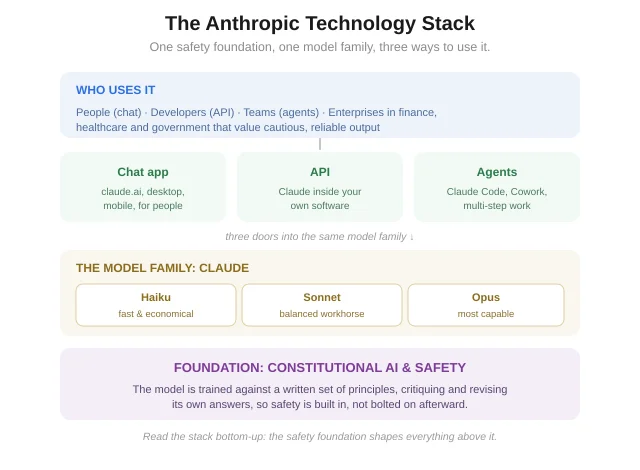
The lineup follows a consistent three-tier logic, named in ascending capability:
Haiku is the fastest and most economical, built for high-volume, simpler tasks where speed and cost matter most.
Sonnet is the balanced workhorse, strong enough for most production work while staying efficient, the default choice for a great deal of real-world use.
Opus is the most capable, made for complex, multi-step reasoning, difficult software engineering, and agentic work where raw capability wins.
Anthropic refreshes this family often, releasing new generations every few months, so the version numbers climb while the three-tier shape stays the same.
The practical takeaway is not to memorize versions but to match the tier to the task: reach for Haiku to do simple things at scale, Sonnet for everyday production, and Opus for the hardest reasoning.
Constitutional AI: The Idea That Makes Anthropic Different
This is the section worth slowing down for, because it is the single thing that most separates Anthropic from its rivals.
Most AI assistants are aligned mainly through human feedback: people rate lots of responses, and the model learns to prefer the highly rated ones. Anthropic pioneered a different method it calls Constitutional AI.
Instead of leaning only on human ratings, the model is given a written set of principles, a "constitution", and trained to critique and revise its own answers against those principles.
In practice, the model generates a response, checks it against the constitution, and rewrites it to better fit those values, producing training signal without needing a human to judge every single example.
The constitution itself draws on sources like the Universal Declaration of Human Rights alongside Anthropic's own safety guidelines.
Why does this matter to a user or a business?
Because it bakes safety and consistency into how the model is trained, rather than bolting filters on afterward.
It is a large part of why Claude has a reputation for careful, structured, comparatively cautious responses, useful when you need an AI you can put in front of customers or rely on for serious work.
The Three Ways to Use Anthropic Technology
Here is the part most guides scatter across ten sections. There are really just three doors into Claude, and which one you use depends on who you are.
The chat app, for people. At claude.ai and in Anthropic's desktop and mobile apps, anyone can talk to Claude directly, ask questions, draft writing, analyze a document, get coding help.
This is the front door, no technical skill required, and it is how most individuals meet the technology.
The API, for developers. The Anthropic API lets developers plug Claude into their own software.
Instead of using Claude through Anthropic's app, they send text to Anthropic's servers and get Claude's response back inside their own product, powering chatbots, document tools, analysis features and more.
This is how Claude ends up inside apps you use without ever seeing the Claude name, much like the way Twilio quietly powers messaging inside apps you already use.
The agents, for real work. Beyond chat and raw API, Anthropic builds agentic tools. The best known is Claude Code, which can take on programming tasks fairly autonomously, while Claude Cowork brings that agentic help to everyday office work.
These are Claude doing multi-step tasks, not just answering a single prompt.
One model family, three ways in. That is the whole product picture.
How Businesses and Developers Actually Use It
With those three doors in mind, the real-world uses become easy to picture.
Businesses use Claude to draft and summarize documents, answer customer questions, analyze large volumes of text, support research, and assist with coding and internal tools.
Because of the safety focus, it appeals in settings, finance, healthcare, government, where cautious, reliable output matters.
Developers use the API to build Claude's capabilities into their own products, and increasingly use Claude Code to accelerate the actual work of writing software.
The models' long context windows, the ability to consider large amounts of text at once, make them well suited to working over big documents and codebases.
The common thread is that Anthropic sells capability, not a single fixed app. You choose how deep to go, from typing in a chat box to wiring Claude into your software.
How Anthropic Compares to OpenAI and Google
You cannot understand Anthropic's place without the two rivals it is usually measured against.
Versus OpenAI, the maker of ChatGPT, the technologies are broadly comparable in raw capability, but the positioning differs.
OpenAI has generally moved faster on consumer features and reach; Anthropic leans harder on safety, alignment and reliability as its defining pitch, which resonates with cautious enterprise and developer buyers.
Notably, Anthropic's founders came from OpenAI.
Versus Google Gemini, Google's advantage is its enormous ecosystem, Search, Workspace, Android, and deep infrastructure.
Anthropic competes not on ecosystem breadth but on the quality and trustworthiness of the model itself, and its strong standing with developers, especially for coding.
The honest summary is that these are all capable frontier models, and the right choice depends on your priorities. If safety, reliability and coding strength top your list, Anthropic makes a strong case.
A fuller side-by-side lives in our Anthropic vs OpenAI comparison.
Pros and Cons of Anthropic Technology
A balanced view before you decide.
The strengths:
A safety-first design via Constitutional AI, producing careful, consistent output
A clear model lineup that lets you balance capability, speed and cost
Strong reputation for reasoning and for software engineering
Flexible access, from a simple chat app to a full developer API and agents
Long context windows suited to large documents and codebases
The trade-offs:
The cautious design can feel more reserved than rivals for some casual uses
Frontier AI pricing and usage costs need managing at scale, like any provider
It is one option among strong competitors, not an automatic default
Rapid model releases mean you should design to swap models easily over time
Is Anthropic Technology Worth Understanding?
For anyone touching AI right now, yes, and not only because of the models.
Anthropic has become one of the most important AI companies in the world, backed by major partners including Amazon and Google, and its Claude models power everything from individual chats to enterprise systems.
Whether or not you choose Claude, understanding how it works, and what Constitutional AI is trying to do, tells you a lot about where responsible AI is heading.
The practical case is simple: Claude is truly strong for writing, reasoning and coding, and the safety focus makes it a comfortable choice where reliability matters.
Treat it as one serious option in your toolkit, match the model tier to the task, and try it on your real work before committing.
Frequently Asked Questions
What is Anthropic technology?
It is the set of AI systems built by Anthropic, an AI safety company: the Claude family of language models, the tools to use them, and the Constitutional AI method behind their training.
What is Anthropic?
Anthropic is an AI safety company founded in 2021 in San Francisco by former OpenAI researchers. It is a public benefit corporation that builds the Claude AI models.
What is Claude AI?
Claude is Anthropic's family of large language models. It can answer questions, write and analyze text, reason through problems and write code, and is Anthropic's competitor to ChatGPT and Gemini.
What is the Anthropic API?
The Anthropic API lets developers add Claude's capabilities to their own software, sending text to Anthropic's servers and receiving Claude's response inside their own applications.
What is Constitutional AI?
It is Anthropic's signature training method, where the model is given a written set of principles and trained to critique and revise its own answers against them, rather than relying only on human ratings.
What are Anthropic's AI models?
Claude comes in three tiers: Haiku for fast, economical tasks, Sonnet as the balanced everyday model, and Opus as the most capable for complex reasoning and coding.
How do businesses use Anthropic technology?
They use Claude to draft and summarize documents, handle customer questions, analyze text, support research and assist with coding, often valuing its safety focus in regulated fields.
How is Anthropic different from OpenAI?
Both build frontier AI, but Anthropic leans harder on safety, alignment and reliability as its core pitch, while OpenAI has generally pushed faster on consumer reach. Anthropic's founders came from OpenAI.
The Bottom Line
Anthropic technology comes down to one company, one model family and one big idea.
The company is a safety-focused AI lab; the model family is Claude, offered in Haiku, Sonnet and Opus tiers; and the big idea is Constitutional AI, training the model against written principles so safety is built in, not added later.
You can reach that technology three ways, through the chat app if you are a person, the API if you are a developer, or agentic tools like Claude Code for real multi-step work.
That flexibility, plus the safety focus, is why Claude shows up everywhere from solo users to large enterprises.
Understand it as one thing offered three ways, guided by one principle, and Anthropic technology stops being a buzzword and becomes something you can actually reason about, and use.