
Search for AdPolice pricing and you will get two contradictory answers. Some sources list a clear $199 a month. Others insist there is no public pricing at all and every plan starts with a sales call.
Both are right, and the reason they are both right is the whole story of what AdPolice actually costs.
The short version: AdPolice BrandProtect starts at a publicly reported $199 per month for its entry plan, but the real price for most brands is a custom quote, because AdPolice charges based on how much you monitor.
Understanding that model is the difference between a nasty surprise on your invoice and a budget you can actually plan.
I analyze SaaS pricing for a living, so this breaks down what is public, what is not, why the entry price can climb fast, and how to know your real number before you ever book a demo.
The Pricing at a Glance
Here is what is publicly reported, with the important caveat that only the entry tier is a fixed figure.
Plan | Reported price | Pricing model | What decides the cost |
|---|---|---|---|
Basic | $199/mo | Flat, monthly | Entry-level monitoring scope |
Higher tiers | Custom quote | Keyword-based | Number of keywords and locations monitored |
Enterprise | Custom quote | Negotiated | Scale, coverage, support level |
Free trial | Available | Time-limited | Feature and scope limits apply |
The $199 figure comes from software review platforms rather than AdPolice's own site. Treat it as a publicly reported starting point and confirm the current rate directly, since it can change and your real cost depends on scope.
Why AdPolice Pricing Looks Different Everywhere
This contradiction confuses buyers, so it is worth resolving clearly before anything else.
Review platforms like Capterra list a $199 entry, with a free trial and a free version noted. That is a real, reported figure, and it is where the public number comes from.
AdPolice's own site, by contrast, does not put pricing front and center.
It steers you toward a demo or a sales conversation, which is standard for tools that price by scope rather than by a fixed plan.
So both statements are true at once. There is a published entry price, and there is a quote-based reality above it. The $199 is the floor, not the whole building.
What Sets AdPolice Pricing Above the Entry Tier
Here is the part most pricing articles miss, and it matters more than the headline number.
AdPolice prices largely by how much you monitor, chiefly the number of branded keywords and the range of locations you track.
The more terms you want watched, and the more countries and engines you want them watched across, the higher your cost climbs above that $199 entry.
For a brand with one name and a handful of keywords, the entry tier may cover it. But for an ecommerce brand with hundreds of product variants, each a potential keyword to protect, the monitoring scope expands quickly, and so does the price.
Verified user feedback flags exactly this: costs climb hard as coverage grows.
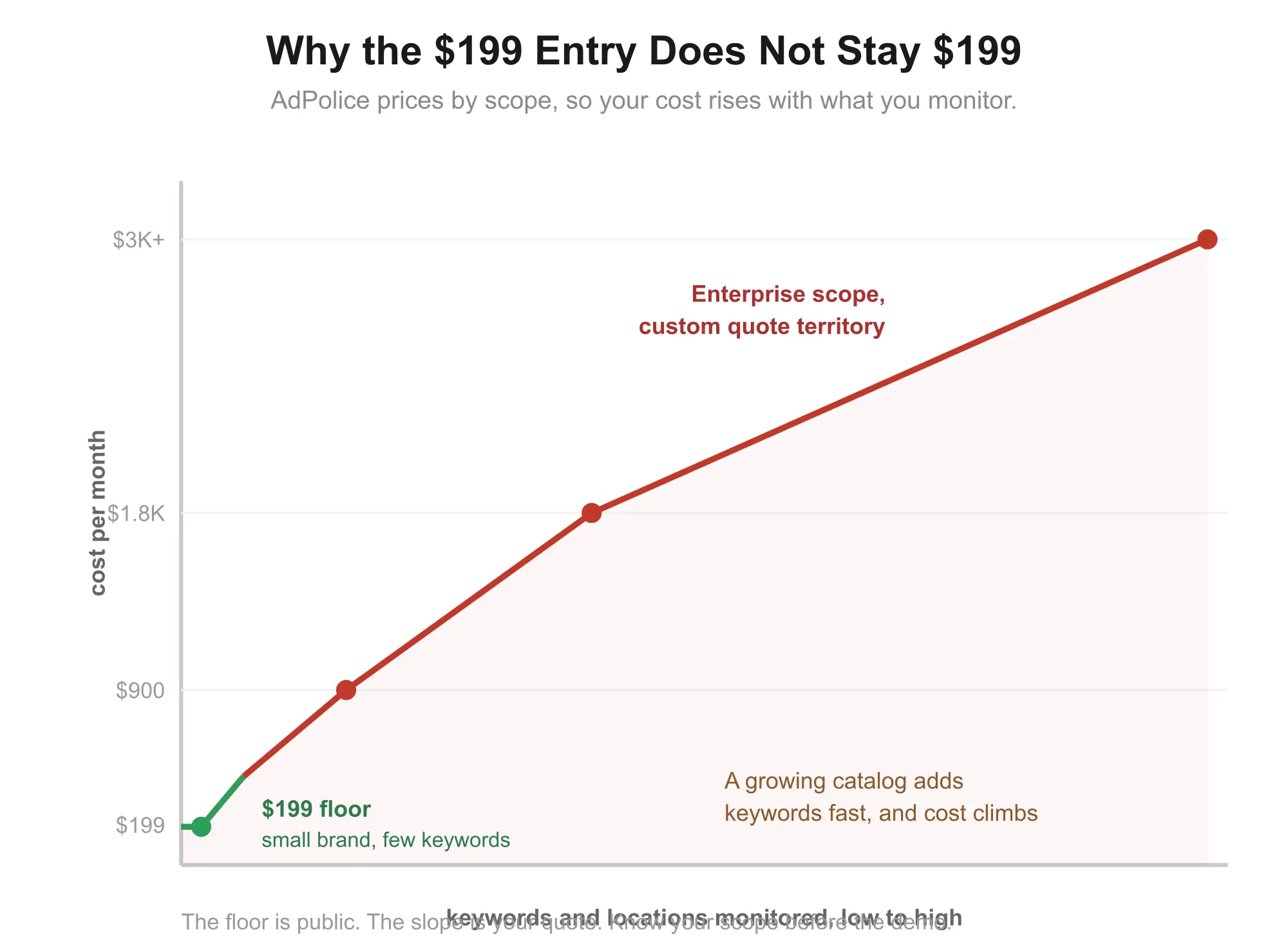 This is why the number feels slippery. AdPolice is not being coy for its own sake. Its price truly depends on a variable only you can define, which is how much of your brand footprint needs watching.
What Your Money Buys
Whatever tier you land on, the underlying capability is consistent, and it helps to know what the spend covers.
An AdPolice subscription buys continuous paid-search monitoring, scanning for competitors and affiliates bidding on your brand across major engines and many locations, refreshed every few minutes.
It also includes the uncloaking tool that exposes cloaked affiliate landing pages as evidence, instant alerts through Slack, Telegram or email, and per-incident compliance reports.
Higher tiers add scale rather than new categories of feature: more keywords, more locations, more team seats, more monitoring frequency, and enterprise support.
You are paying for breadth and depth of coverage, not for unlocking fundamentally different tools.
That is a reasonable model for what it is. The value scales with your exposure, which for a large brand under constant attack is defensible, and for a small brand with a narrow footprint keeps the entry cost contained.
Does AdPolice Offer a Free Trial?
Yes, and this matters given the quote-based pricing above the entry tier.
AdPolice offers a free trial that lets you test the platform before committing, and review platforms also note a free version.
The trial does come with limits on features and monitoring scope, so it is a way to judge the interface and the detection quality, not a way to run a full program for free.
For a tool where your real price depends on your scope, using the trial to understand how much monitoring you actually need is the smartest possible first step. It turns the quote conversation from a guess into an informed negotiation.
Is AdPolice Worth the Price?
Value in a tool like this is not about the sticker number, it is about what a violation costs you when it goes uncaught.
If competitors and affiliates bidding on your brand are actively siphoning clicks and inflating your ad costs, AdPolice's monitoring can pay for itself by recovering that traffic and enforcing your agreements.
For a brand spending heavily on paid search, $199 and up is small against the ad budget it protects.
If brand bidding is a hypothetical worry rather than a measured, recurring problem, the math is harder. Paying a scope-based price to monitor a threat you have not confirmed is how software budgets get wasted.
In that case, a cheaper self-serve tool to first find out whether you have a problem makes more sense.
The honest test is simple: do you have evidence that brand bidding is costing you money right now? If yes, AdPolice is likely worth it. If you are not sure, find out cheaply before you commit to a scope-based contract.
Best Alternatives by Budget
If AdPolice's model or price does not fit, the category offers options at every level, and matching them to budget is simple.
On a tight, transparent budget, self-serve tools like Bluepear (around $199 a month) and SEMSCOUT (from roughly €139 a month) publish their prices and let you start without a sales call.
That is the opposite of AdPolice's quote-based approach above the entry tier.
At a comparable mid-market level, BrandVerity and The Search Monitor offer similar paid-search protection, though they too lean quote-based and sit at a similar or higher price point.
For a different problem entirely, marketplace and counterfeit threats, tools like Red Points and Corsearch are the right category, priced at the enterprise end.
For the full field mapped by which job each tool does, this guide to AdPolice alternatives compares the realistic options in one place.
Frequently Asked Questions
How much does AdPolice cost?
Publicly reported pricing starts at $199 a month for the Basic plan. Higher tiers are custom quotes based on how many keywords and locations you monitor.
Does AdPolice publish its pricing?
Only partly. Review platforms report a $199 entry price, but AdPolice's own site steers buyers to a demo, since most plans are quote-based by scope.
Does AdPolice offer a free trial?
Yes, a free trial is available with limits on features and monitoring scope, letting you test the platform before committing to a paid plan.
Why is AdPolice pricing hard to find?
Because it prices largely by monitoring scope, the number of keywords and locations, so above the entry tier there is no single fixed figure to publish.
What makes the price go up?
Chiefly the number of branded keywords and the range of locations and engines you monitor. Brands with many product variants see costs climb fastest.
Is AdPolice worth the cost?
For brands with a confirmed, costly brand-bidding problem, usually yes, since it protects a larger ad budget. For an unconfirmed worry, a cheaper tool to check first is wiser.
How does AdPolice pricing compare to BrandVerity?
Both sit at a mid-market level and both lean quote-based. AdPolice publishes a lower $199 entry point, while BrandVerity is often flagged as expensive for smaller brands.
What is the cheapest alternative?
SEMSCOUT from around €139 a month and Bluepear from about $199, both self-serve and transparently priced, are the budget-friendly options.
The Bottom Line
AdPolice pricing is best understood as a floor plus a formula. The floor is a publicly reported $199 a month. The formula is scope: the more keywords and locations you monitor, the higher your real cost climbs into custom-quote territory.
That model is not a trick, it is a fair reflection of the fact that protecting a large brand footprint costs more than protecting a small one.
The mistake is walking into a demo without knowing your own scope, and letting the quote define your budget instead of the other way around.
Work out how much of your brand you actually need watched, use the free trial to confirm it, and you turn AdPolice's slippery pricing into a number you control.
That preparation, not the headline figure, is what decides whether AdPolice is a smart buy for you.