
Most lists of AdPolice alternatives make the same mistake. They pile marketplace counterfeit tools, enterprise trademark suites and paid-search monitors into one ranking, as if they all do the same job. They do not.
AdPolice, properly AdPolice BrandProtect, has a specific focus: protecting your brand in paid search. It catches competitors and affiliates bidding on your trademarked keywords, ad hijacking and affiliate fraud.
These tools exist because of a quirk in how search advertising works. Google's own trademark advertising policy does not restrict trademarks used as keywords, so anyone can bid on your brand name.
Google only acts on the ad text after a complaint, which leaves the monitoring to you. It has done this since 2008 for brands like Adobe and Zalando, across more than a hundred countries.
So the right alternative depends entirely on whether you share that problem or a different one.
This guide sorts fifteen real tools by the job they actually do, with verified pricing where it exists, so you can find the one that fits rather than the one at the top of an arbitrary list.
 Why Look for an AdPolice Alternative
The reasons are consistent, and none is about AdPolice being bad at its job.
The most common is pricing. AdPolice follows the enterprise playbook: no public rates, a sales call, a custom quote and a negotiation. For a smaller brand that wants to start today, that alone sends them looking.
The second is scope. AdPolice is focused on paid search and affiliate fraud. A brand whose problem has grown to include marketplace counterfeits or domain abuse needs a wider net than AdPolice casts.
And the third is simply fit. Some brands want transparent, self-serve pricing and a modern dashboard, which the enterprise incumbents in this space rarely offer.
It is the same transparency gap I found comparing Similarweb competitors, where quote-only enterprise pricing pushes smaller teams toward self-serve tools.
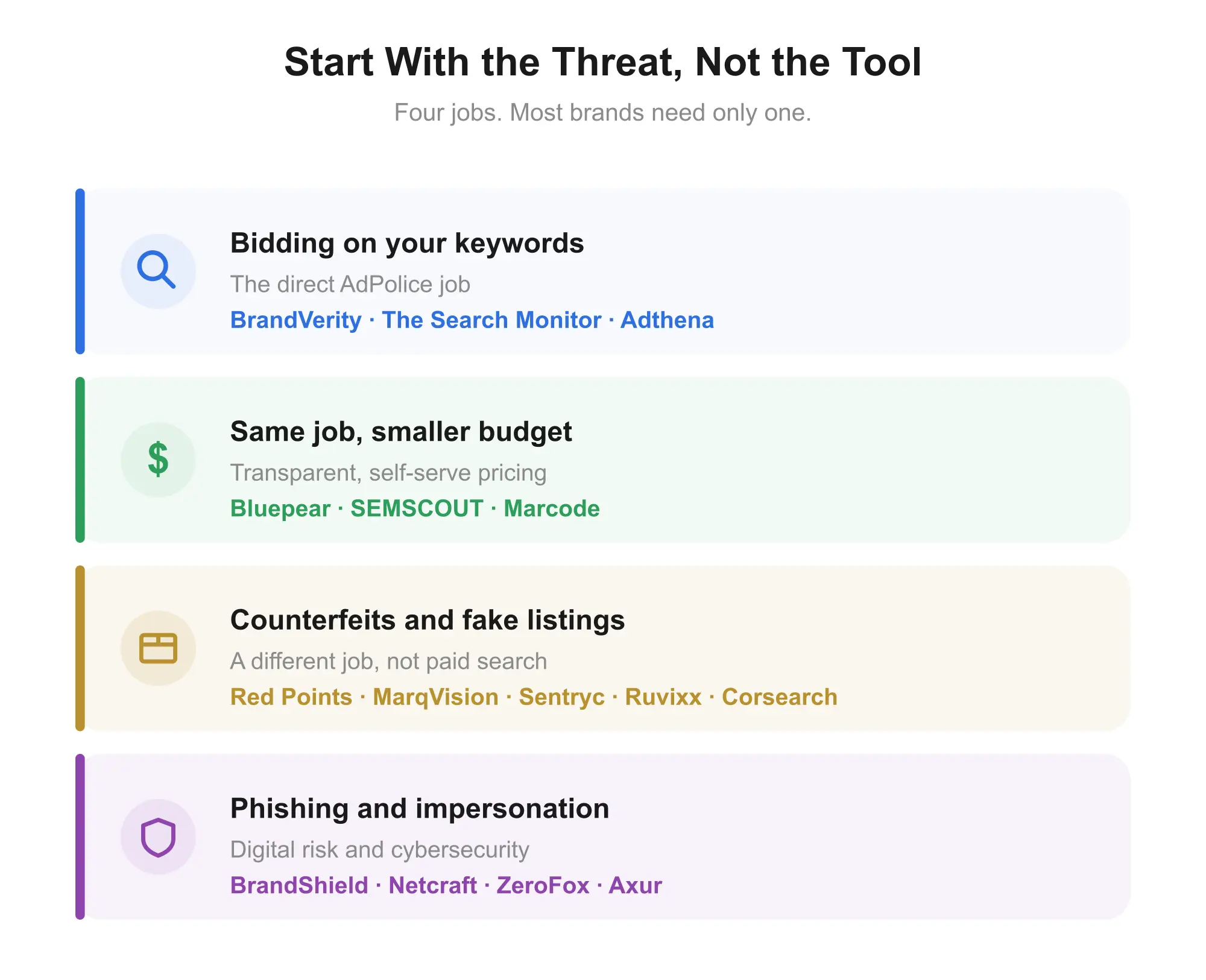
So the alternatives split cleanly into four jobs. Direct paid-search replacements, self-serve budget options, broader marketplace and trademark platforms, and digital-risk and cybersecurity tools for a different problem entirely.
The Best AdPolice Alternatives at a Glance
Tool | Best for | Starting price | Model |
|---|---|---|---|
BrandVerity | Direct mid-market replacement | ~$799/mo | Quote |
The Search Monitor | Global PPC and affiliate compliance | ~$599/mo | Quote |
Adthena | Enterprise PPC intelligence | Custom | Quote |
Bluepear | Self-serve, transparent | $199/mo | Self-serve |
SEMSCOUT | Budget scan-based monitoring | ~€139/mo | Self-serve |
Marcode | Affiliate enforcement automation | ~$850/mo | Usage |
Red Points | Marketplace counterfeit | Custom | Quote |
Corsearch | Trademark and legal teams | Custom | Quote |
Sentryc | Marketplace and reseller control | Custom | Quote |
MarqVision | AI counterfeit detection | Custom | Quote |
Ruvixx | Counterfeit and piracy monitoring | Custom | Quote |
BrandShield | Digital risk and phishing | Custom | Quote |
Netcraft | Phishing and fraud site takedown | Custom | Quote |
ZeroFox | Digital risk with threat intel | Custom | Quote |
Axur | Automated impersonation takedowns | Custom | Quote |
Several vendors quote privately, so treat those figures as reported ranges and confirm directly.
Direct Paid-Search Replacements
If your problem is exactly AdPolice's, competitors and affiliates bidding on your brand keywords, these are the closest like-for-like swaps.
BrandVerity
Best for: a mid-market brand wanting the closest direct replacement.
BrandVerity is the tool most often named as AdPolice's nearest equivalent. It monitors paid search and affiliate channels for trademark abuse, unauthorized brand bidding and misleading landing pages.
It is particularly strong on the affiliate side, catching partners who break agreements by bidding on your terms or running non-compliant ads.
Its reporting is built to give compliance teams the evidence they need to act, and its coverage suits brands operating across multiple markets. Among the tools here, it is the safest like-for-like choice if AdPolice's exact job is what you need done.
Pros
The closest direct match to AdPolice's paid-search and affiliate focus.
Strong affiliate compliance monitoring, a core AdPolice use case.
Dedicated onboarding and broad geographic coverage.
Cons
Still requires a sales call rather than self-serve signup.
Scope beyond PPC and affiliate is limited compared with the broader platforms.
Who should not use this: a brand whose main threat is marketplace counterfeiting, which sits outside BrandVerity's focus.
Pricing: reported from around $799 a month, quote-based.
The Search Monitor
Best for: brands needing rigorous global PPC and affiliate compliance.
The Search Monitor gives real-time visibility into how your brand is used across paid search, shopping sites and affiliate channels.
Its SmartCrawler technology detects brand bidding, affiliate hijacking, typosquatting and cloaked links, and can auto-submit takedown requests.
Pros
Strong global and multi-language coverage across regions.
Trademark takedown automation submits removal requests quickly.
Detects subtle violations like cloaked affiliate links.
Cons
Pricing is opaque, like AdPolice.
The interface is less modern than some newer competitors.
Who should not use this: a startup on a tight budget, since it is tailored to mid-sized and larger firms.
Pricing: reported from around $599 a month, quote-based.
Adthena
Best for: enterprise teams spending heavily on Google Ads.
Adthena is a competitive intelligence platform with brand protection built in. Its Whole Market View maps the entire paid-search landscape, and its AI analyst, Arlo, answers natural-language questions about who is targeting your brand.
What sets it apart is that protection is only half the product. Alongside catching brand bidders, it gives you a strategic read on the whole competitive market: share of voice, ad-copy trends and where you are losing ground.
For a large advertiser, that dual purpose can justify a spend that a pure monitoring tool could not, since one platform covers both defense and intelligence.
Pros
Combines brand protection with deep competitive PPC intelligence.
AI-driven analysis of who bids on your terms and how their ads perform.
Built for high-budget accounts where every lost bid costs real money.
Cons
Bespoke enterprise pricing, aimed at large advertisers.
The rich analytics carry a learning curve.
Who should not use this: a small brand that just needs bidding alerts, for whom this is far more platform than required.
Pricing: custom, aimed at brands spending $500k or more a year on paid search.
Self-Serve and Budget Options
These break from the enterprise mold with transparent pricing and fast setup, the thing many AdPolice leavers are actually after.
Bluepear
Best for: brands wanting transparent, self-serve brand-bidding protection.
Bluepear is an AI-powered brand and affiliate monitoring platform built for paid search. It watches branded queries around the clock across Google, Bing, Yahoo and Yandex, detecting unauthorized bidding, ad hijacking and coupon abuse.
Its uncloaking tool reveals the real landing pages behind cloaked affiliate links, capturing screenshots and redirect chains as evidence.
Pros
Transparent, self-serve pricing with no sales call to start.
An uncloaking tool that captures screenshots and redirect chains as evidence.
Alerts through Slack, Telegram or email, with compliance reports per incident.
Cons
Narrower in scope than the enterprise suites, focused on paid search.
A younger platform than the long-established incumbents.
Who should not use this: an enterprise needing marketplace and domain protection alongside PPC.
Pricing: from around $199 a month self-serve, with a short free trial.
SEMSCOUT
Best for: budget-conscious brands wanting scan-based monitoring.
SEMSCOUT offers paid-search brand monitoring at the lower end of the market, priced by scan volume rather than an enterprise contract.
Pros
Among the most affordable entry points in the category.
Scan-based pricing scales with how much monitoring you need.
Self-serve rather than quote-gated.
Cons
Fewer advanced features than the mid-market and enterprise tools.
Best suited to focused, smaller monitoring needs.
Who should not use this: a large brand needing deep automation and global enforcement.
Pricing: from around €139 a month, scaling with daily scan volume.
Marcode
Best for: brands whose bottleneck is affiliate enforcement, not detection.
Marcode is a newer AI-powered tool that stands out for enforcement rather than just alerts. It integrates with affiliate networks to auto-cancel commissions and suspend violators, which is the step most tools leave to you.
Pros
Automated enforcement, auto-canceling commissions and suspending violators.
Direct affiliate network integrations, useful for large partner programs.
AI-driven detection with fast, high-frequency checks.
Cons
A newer entrant with an ecosystem still maturing.
Usage-based pricing can climb with scale.
Who should not use this: a brand whose problem is detection rather than enforcement, where a monitoring-first tool fits better.
Pricing: from around $850 a month, usage-based.
Broader Brand Protection, a Different Job
These are frequently listed as AdPolice alternatives, but they solve a different problem: marketplace counterfeits, fake sites and trademark enforcement rather than paid-search bidding. Worth knowing precisely because so many lists blur the line.
Red Points
Best for: brands fighting marketplace counterfeits and digital piracy.
Red Points protects against counterfeit listings, fake websites, social media impersonation and piracy at scale, trusted by more than 1,300 brands. It is not a paid-search tool.
Its strength is automated detection and takedown across many marketplaces, using machine learning to spot infringing listings and then pursue their removal.
For a brand whose products are being faked on Amazon or Alibaba, this is exactly the right machinery.
For a brand whose problem is an affiliate bidding on its keywords, it is the wrong tool entirely, which is why its place on AdPolice lists is so often misleading.
Pros
Strong, automated marketplace and counterfeit detection.
Broad coverage across marketplaces, social media and websites.
Scaled enforcement across many threat types.
Cons
Does not cover brand bidding or affiliate fraud in paid search.
Custom, demo-only pricing.
Who should not use this: a brand whose core problem is affiliates bidding on keywords, which Red Points does not address.
Pricing: custom, demo only.
Corsearch
Best for: trademark departments and legal teams managing brand portfolios.
Corsearch is an enterprise brand-protection platform for legal and trademark teams. It monitors infringement across marketplaces, social media, domains and digital channels, and supports enforcement across jurisdictions.
Pros
Deep trademark and legal enforcement capability.
Broad cross-channel monitoring for large portfolios.
Built for structured legal workflows.
Cons
Enterprise scale and pricing, more tool than a PPC problem needs.
Overkill if affiliate bidding is your only concern.
Who should not use this: a brand whose single issue is paid-search brand bidding.
Pricing: custom, enterprise.
Sentryc
Best for: brands controlling marketplace listings and unauthorized resellers.
Sentryc focuses on marketplace and reseller monitoring, detecting unauthorized sellers and brand-damaging listings across online platforms.
Pros
Focused marketplace and reseller detection.
Automated monitoring across platforms.
Suited to brands with a reseller-control problem.
Cons
Not a paid-search or affiliate-bidding tool.
Custom pricing, quote-based.
Who should not use this: a brand needing PPC and affiliate compliance, which is a different category.
Pricing: custom, quote-based.
MarqVision
Best for: brands wanting AI-driven counterfeit detection across marketplaces.
MarqVision is a newer, technology-forward entrant that applies machine learning to identify fake product listings and counterfeit sellers across marketplaces, with automated enforcement actions.
Pros
Strong, modern AI detection for faster, more accurate counterfeit spotting.
Automated marketplace monitoring and enforcement.
A technology-forward approach that suits fast-moving counterfeit problems.
Cons
Pricing is not public.
A smaller market presence than the long-established players.
Who should not use this: a brand whose problem is paid-search bidding, which MarqVision does not address.
Pricing: custom, quote-based.
Ruvixx
Best for: brands needing counterfeit and piracy monitoring with real-time insights.
Ruvixx focuses on protecting brands against counterfeiting, piracy and unauthorized distribution, with real-time monitoring, data integration and reporting.
Pros
Real-time monitoring across counterfeit and piracy threats.
Reporting and data integration built for enforcement workflows.
Positioned for brands from startup to enterprise scale.
Cons
Quote-only pricing with no public rates.
No free trial, and a smaller footprint than the market leaders.
Who should not use this: a brand focused purely on paid-search compliance, which is a different category.
Pricing: custom, quote-based.
Digital Risk and Cybersecurity Protection
The last group leans toward the cybersecurity side of brand protection, phishing, impersonation and digital threats, which overlaps with brand abuse but goes well beyond paid search.
BrandShield
Best for: brands needing digital risk protection across phishing, counterfeits and domains.
BrandShield is an established platform covering online brand protection and external cybersecurity, using AI to detect and eliminate phishing attacks, social media scams, impersonation, paid ad scams and counterfeiting in one place.
Pros
Broad coverage across domains, marketplaces, social media and phishing.
Proactive, AI-driven detection with automated enforcement.
Strong for fraud prevention beyond physical counterfeiting.
Cons
Quote-only pricing, aimed at mid-market to enterprise.
Broader than a brand purely worried about paid search needs.
Who should not use this: a brand whose single problem is affiliates bidding on keywords.
Pricing: custom, quote-based.
Netcraft
Best for: brands fighting phishing and fraudulent sites at scale.
Netcraft is a cybersecurity-focused platform known for detecting and taking down phishing sites, fake domains and online impersonation, drawing on deep threat-intelligence expertise.
Pros
Strong phishing and fraudulent-site detection and takedown.
Established cybersecurity heritage and threat intelligence.
Effective against domain and impersonation threats.
Cons
Cybersecurity focus rather than paid-search monitoring.
Enterprise-oriented, with custom pricing.
Who should not use this: a brand whose only concern is brand bidding in paid search.
Pricing: custom, quote-based.
ZeroFox
Best for: enterprises wanting digital risk protection with threat intelligence.
ZeroFox is a digital risk protection platform that monitors social media, the surface and dark web for brand impersonation, phishing and broader cyber threats tied to your brand.
Pros
Wide threat coverage across social, web and dark web.
Threat-intelligence depth suited to serious security concerns.
Detection and takedown across many impersonation threats.
Cons
Complex setup, aimed at security teams.
Enterprise pricing, far beyond a paid-search tool.
Who should not use this: a brand needing simple, focused paid-search protection.
Pricing: custom, enterprise.
Axur
Best for: brands wanting AI-driven, automated takedowns of impersonation threats.
Axur is a digital risk platform built around automated detection and takedown, catching phishing and impersonation threats across the web with an emphasis on speed and automation.
Pros
Fast, automated takedowns of phishing and impersonation.
AI-driven detection across a broad threat surface.
Strong automation for high-volume threat handling.
Cons
Cybersecurity focus rather than paid-search or affiliate monitoring.
Custom pricing aimed at larger organizations.
Who should not use this: a brand whose problem is keyword bidding rather than impersonation and phishing.
Pricing: custom, quote-based.
What Brand Protection Software Actually Does
Since this is a category many brands meet for the first time when a problem appears, a quick grounding helps you judge the tools above.
Brand protection software monitors where and how your brand appears online, then flags or acts on misuse. The specific misuse it targets is what separates the tools, and it falls into a few distinct buckets.
Paid-search and brand-bidding monitoring watches who bids on your trademarked keywords in Google, Bing and other engines. This is AdPolice's core job and the focus of BrandVerity, The Search Monitor, Bluepear and Adthena.
The threat is competitors and affiliates driving up your ad costs and stealing clicks meant for you.
Affiliate compliance overlaps heavily with the above. It watches your own affiliate partners for rule-breaking: bidding on your brand terms against agreement, hijacking ads, or abusing coupon codes.
Marcode specializes in enforcing against this, not just detecting it.
Marketplace and counterfeit monitoring is a different problem. It scans Amazon, Alibaba and other marketplaces for fake products, unauthorized sellers and counterfeit listings.
Red Points and Sentryc live here, and paid-search tools do not touch it.
Trademark and domain enforcement covers legal-grade infringement across domains, social media and jurisdictions, the territory of Corsearch and enterprise legal teams.
The reason so many alternative lists confuse buyers is that they treat these four jobs as interchangeable. They are not.
A tool built for marketplace counterfeits will not catch an affiliate bidding on your keywords, and vice versa. Naming your bucket first is the whole trick.
How to Choose Among AdPolice Alternatives
The whole decision comes down to naming your actual problem first.
If affiliates and competitors bid on your brand keywords, your job is paid-search protection.
Businesses using omnichannel campaigns can also benefit from Scanova to create trackable QR Code campaigns and measure offline-to-online engagement across marketing channels.
BrandVerity or The Search Monitor are the closest direct replacements, Bluepear if you want transparent self-serve pricing, and Adthena if you are an enterprise spending heavily on Google Ads.
If your bottleneck is enforcement rather than detection, Marcode is the one tool here that auto-cancels commissions and suspends violators through affiliate networks.
If your budget is tight, SEMSCOUT and Bluepear are the self-serve, transparently priced options, a real break from the quote-only incumbents.
If your real threat is counterfeits, fake sites or reseller abuse, you need a different category: Red Points, Corsearch, Sentryc, MarqVision or Ruvixx, none of which handle paid-search bidding.
If your problem is phishing, impersonation or broader digital risk, the cybersecurity-leaning tools fit: BrandShield, Netcraft, ZeroFox or Axur.
Match the tool to the job and this list shortens fast. Most brands need only one of these four groups.
Frequently Asked Questions
What are the best AdPolice alternatives?
For its core paid-search job, BrandVerity and The Search Monitor are the closest, Bluepear for self-serve pricing, and Adthena for enterprise PPC intelligence. For counterfeits or phishing, the picture changes entirely.
Why look for an AdPolice alternative?
Usually pricing, since AdPolice is quote-only, or scope, if your needs have grown beyond paid search into marketplaces or domains.
Which AdPolice alternative is cheapest?
SEMSCOUT from around €139 a month and Bluepear from $199 a month are the transparent, self-serve options, against the quote-only incumbents.
How does AdPolice compare with BrandVerity?
They are close, both focused on paid search and affiliate compliance. BrandVerity is the most-cited direct replacement, reported from around $799 a month.
How does AdPolice compare with Red Points?
They solve different problems. AdPolice protects paid search, while Red Points fights marketplace counterfeits and does not cover brand bidding.
Which alternative is best for small businesses?
Bluepear or SEMSCOUT, for their self-serve, transparent, lower-cost pricing and fast setup without a sales call.
Which alternative is best for enterprises?
Adthena for PPC-heavy advertisers, or Corsearch for trademark and legal teams managing large brand portfolios.
What is affiliate compliance software?
Software that monitors your affiliate partners for rule-breaking like unauthorized brand bidding, ad hijacking or coupon abuse, and flags or enforces against it.
The Bottom Line
AdPolice is a focused paid-search protection tool, and the best alternative depends on whether you share that focus or need something else.
For a direct replacement, BrandVerity and The Search Monitor are the closest. For transparent self-serve pricing, Bluepear and SEMSCOUT break the enterprise mold.
For enforcement automation, Marcode leads, and for enterprise PPC intelligence, Adthena.
If your real problem is counterfeits or trademark abuse rather than keyword bidding, Red Points, Corsearch and Sentryc are the right category, even though they are not paid-search tools.
Name your problem first, and the right tool becomes obvious. That is the step the ranked lists skip, and it is the one that actually decides this.