
Here is the verdict first, because you are probably deciding whether to book a demo.
AdPolice is a serious, focused paid-search brand protection tool that does one job unusually well, catching people who bid on your brand and abuse your affiliate program, and it charges accordingly.
Whether that is worth it comes down to a single question, which this review is built to answer: is paid-search brand bidding actually your problem?
If it is, AdPolice is one of the strongest tools for it. If your threat is somewhere else, you would be paying enterprise money for coverage you do not need.
I weigh compliance and monitoring tools for a living, so what follows is grounded in AdPolice's real capabilities, its verified pricing, and what actual users say after living with it, the good and the frustrating both.
AdPolice Review: What It Is, in One Read
AdPolice, sold as AdPolice BrandProtect, is a digital brand safety platform. Strip away the marketing language and it does something specific: it watches where your brand name shows up in paid advertising and flags anyone misusing it.
 The people misusing it are usually two groups. Competitors bidding on your trademarked keywords to steal your clicks, and your own affiliate partners breaking their agreements by bidding on your brand, hijacking your ads, or abusing coupon codes.
This is possible because Google's ad policy does not stop anyone bidding on your brand name as a keyword, so the monitoring falls to you.
It has done this since 2008 for hundreds of brands, agencies and affiliate networks worldwide. That longevity matters in a category where trust is the product, though as we will see, it also shows in the interface.
The Thing It Does Better Than Most: Detection Depth
Rather than march through a feature list, it is more useful to look at where AdPolice actually earns its keep, and that is the depth and frequency of its monitoring.
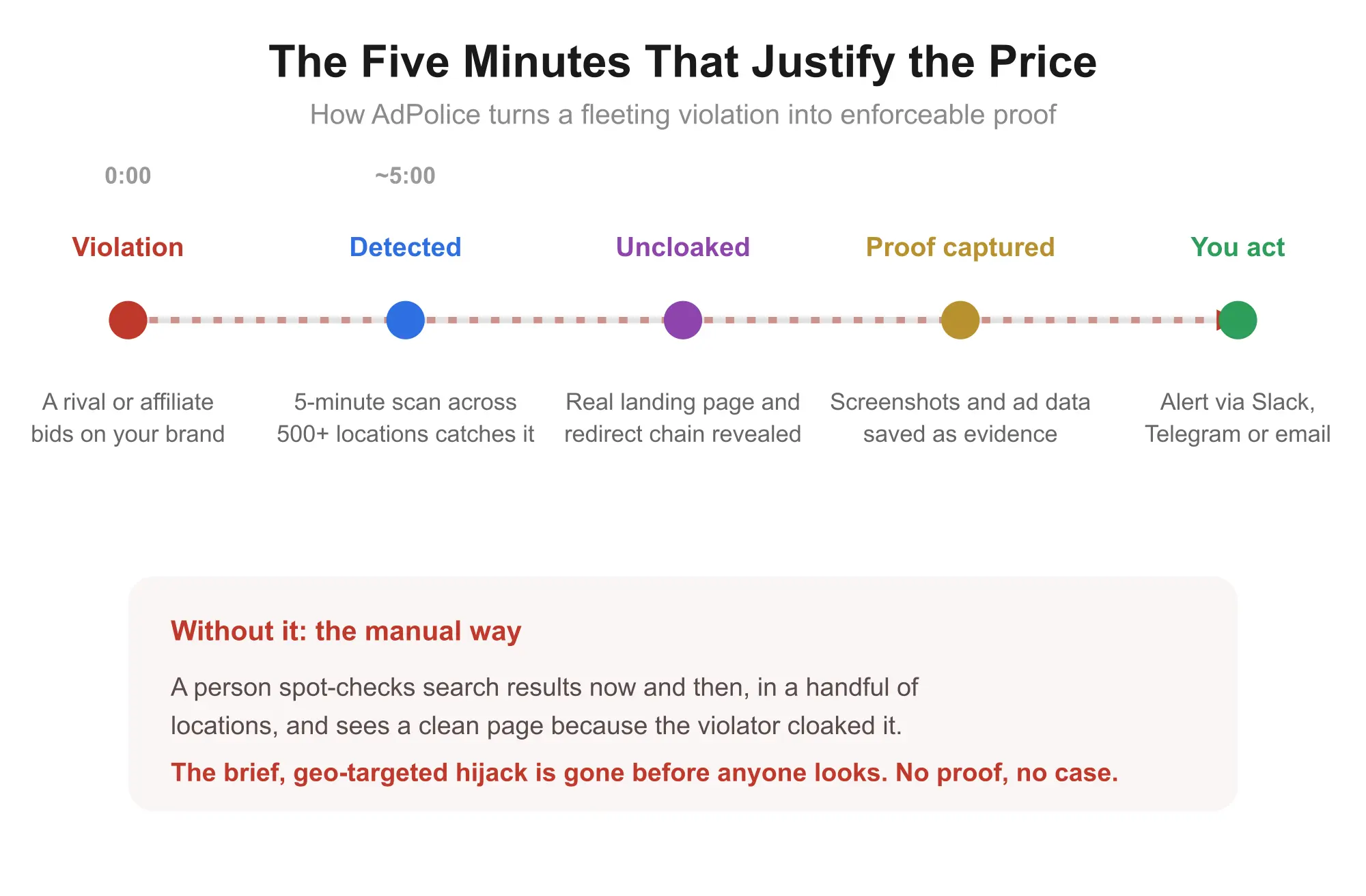
AdPolice checks your branded keywords every five minutes, across more than 500 global locations and 40-plus countries, on Google, Bing, Yahoo and Yandex, plus mobile and regional search.
That scan frequency is among the highest in the market, and it matters because ad hijacking is often brief and geographically targeted.
A violation that surfaces for an hour in one country is exactly what a slow, manual audit misses and a five-minute scan catches.
Its standout technical feature is the uncloaking tool. Affiliate violators often hide behind cloaked links that show a clean page to detection systems and the real, rule-breaking page to everyone else.
AdPolice reveals the actual landing page and the full redirect chain behind those links, and captures screenshots and ad data as evidence.
For an affiliate manager trying to enforce agreements, that evidence trail is the difference between suspecting a violation and proving it.
Findings land in a single dashboard with instant alerts through Slack, Telegram or email, and you can generate a structured compliance report for each incident.
The whole system is built for one workflow: detect misuse fast, prove it, act on it.
 Where It Falls Short: The Honest Part
No review is worth reading if it only lists strengths, and AdPolice has real, consistently reported weaknesses.
The most common complaint is the interface. Verified users describe it as outdated and not easy to navigate, with a learning curve that takes time to climb.
One long-term user noted the platform is not intuitive at first and that setup can be complex. It works, and people grow comfortable with it, but it is not a modern, polished experience.
The second is price. AdPolice sits at the expensive end, and while its entry is more accessible than pure enterprise suites, its higher tiers carry custom quotes that some users flag as steep. You are paying for depth, not for a bargain.
There are smaller gripes too, bulk downloads occasionally timing out, and an initial setup that has not always offered the right account type from the start.
None of these is a dealbreaker, but an honest review names them, and they cluster around usability rather than capability.
What Real Users Actually Say
Beyond the spec sheet, the verified user sentiment is consistent enough to be useful.
On the positive side, users repeatedly praise the detailed reporting, the responsive customer support, and the way AdPolice brings order to sprawling affiliate programs.
One affiliate manager described it as bringing structure to programs that are otherwise overwhelming to police, making every publisher play by the same rules.
Another highlighted value for money and flexibility without needing to integrate anything on their own site.
On the negative side, the theme is always usability, the interface and the learning curve, never the core detection, which users trust.
That split is telling. People do not complain that AdPolice fails to catch violations. They complain that getting comfortable with the tool takes effort.
For a brand protection tool, that is arguably the right place to have your weaknesses. Detection is the job, and detection is what users rate highly.
How It Rates
Pulling the threads together into a scorecard, weighted for what a brand protection tool is actually for.
Dimension | Rating |
|---|---|
Detection and coverage | 4.5 / 5 |
Reporting and evidence | 4.5 / 5 |
Ease of use | 3 / 5 |
Pricing and value | 3.5 / 5 |
Support | 4 / 5 |
Overall | 4 / 5 |
The scorecard tells the story cleanly: AdPolice is excellent at the job it exists to do and merely acceptable at being pleasant to use. For a compliance tool, most buyers weight the first far above the second.
Pricing, and Whether It Is Worth It
AdPolice starts at $199 a month for its Basic plan, with custom enterprise pricing above that for larger organizations, and a free trial that lets you test before committing, though the trial has some feature limits.
That $199 entry is worth putting in context. It is far more accessible than the pure enterprise brand-protection suites that quote thousands a month, yet it sits well above budget monitoring tools.
AdPolice occupies a mid-to-upper position: serious capability, priced for brands that treat brand protection as a real line item.
Is it worth it? If competitors and affiliates bidding on your brand are actively costing you clicks and margin, the answer is usually yes, since the tool pays for itself by recovering traffic and enforcing agreements.
If brand bidding is a hypothetical worry rather than a live problem, the price is harder to justify, and a cheaper self-serve option may serve you better while you find out.
Who Should Use AdPolice
The fit is specific, and being specific about it saves you money.
AdPolice suits brands with active affiliate programs, where policing dozens or hundreds of publishers by hand is impossible and the uncloaking evidence trail is truly valuable.
It also suits companies in high-competition paid-search categories, ecommerce, travel, pharma, iGaming, where rivals bidding on your brand is a constant, costly reality.
And it suits agencies and affiliate networks managing compliance across many clients or partners at once.
The common thread is scale and stakes. If you have enough paid-search and affiliate activity that manual monitoring has broken down, AdPolice is built precisely for you.
Who Should Look Elsewhere
Equally important, the brands for whom AdPolice is the wrong buy.
If your real threat is marketplace counterfeits, fake websites or product piracy, AdPolice does not address that, and a marketplace-focused platform fits far better.
If you want competitive ad-creative research, finding winning ad formats and analyzing competitor copy, that is a different category entirely, since AdPolice monitors compliance, not creative.
And if you are a small brand testing whether brand bidding is even an issue, a cheaper self-serve tool lets you find out without the commitment.
If any of those describes you, the honest move is to look at what else the category offers before booking an AdPolice demo. I mapped the full field, sorted by which job each tool actually does, in this guide to AdPolice alternatives.
Frequently Asked Questions
Is AdPolice worth it?
For brands with active affiliate programs or heavy paid-search competition, generally yes. Its detection depth and evidence tools justify the price when brand bidding is a real, costly problem.
Is AdPolice a good brand protection platform?
Yes, within its focus. It is one of the strongest tools for paid-search brand bidding and affiliate compliance, though it does not cover marketplace counterfeits.
How much does AdPolice cost?
From $199 a month for the Basic plan, with custom enterprise pricing for larger needs. A free trial is available with some feature limits.
Does AdPolice offer a free trial?
Yes, a free trial lets you test the platform before committing, though it may limit certain features and monitoring scope.
What are the main pros and cons?
Pros: deep, frequent detection, strong evidence and reporting, responsive support. Cons: dated interface, a learning curve, and pricing that climbs at higher tiers.
Who should use AdPolice?
Brands with affiliate programs, companies in competitive paid-search verticals, and agencies or networks managing compliance across many partners.
How does AdPolice compare to BrandVerity?
They are close competitors, both focused on paid search and affiliate compliance. BrandVerity is often cited as the nearest alternative, at a comparable mid-market price point.
What are the best AdPolice alternatives?
That depends on your actual job, from direct paid-search rivals like BrandVerity to budget self-serve tools and marketplace-focused platforms for a different threat.
The Verdict
AdPolice earns a solid four out of five, and the score comes with a clear condition attached: it is the right tool if paid-search brand protection is really your problem.
Its detection is deep and fast, its evidence tools are built for real enforcement, and its long track record and responsive support back it up.
The real caveats are a dated interface and a price that suits brands treating brand protection as an investment rather than an experiment.
Match AdPolice to a brand fighting active brand bidding and affiliate abuse, and it is an easy recommendation. Ask it to solve counterfeits, creative research, or a problem you are not sure you have yet, and it is the wrong tool.
Know which of those you are, and the decision makes itself.