
Registering a trademark is the easy part. Keeping it protected is the job that never ends, because someone, somewhere, is always filing a mark, launching a product or registering a domain that edges too close to yours.
Trademark monitoring software is what watches for that so you do not have to.
But here is the distinction most buyers miss, and it matters more than any feature list.
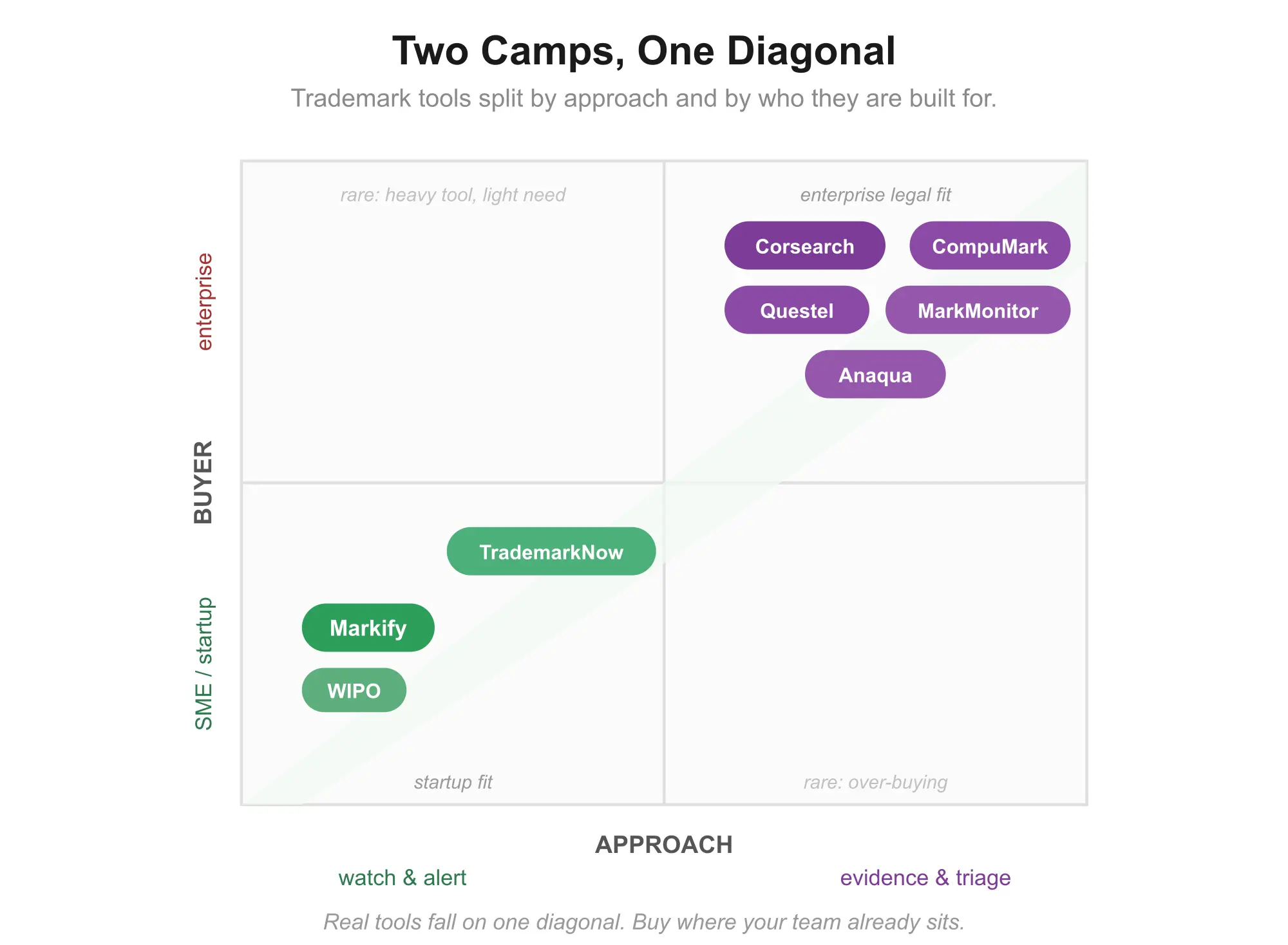
Trademark monitoring tools split into two camps: those built to alert you fast when something new is filed, and those built to hand your lawyers a case-ready file.
They solve the same problem from opposite ends, and buying the wrong type wastes money.
This guide sorts eight real platforms by that divide and by who they fit, so you can find the one that matches how your team actually works. Every tool is verified for what it does in 2026.
What Trademark Monitoring Software Does
A quick foundation before the tools, because the category is narrower and more specific than general brand protection.
Trademark monitoring software continuously tracks new trademark filings, status changes and potential conflicts across the jurisdictions you care about, then alerts you when something similar to your mark appears.
It replaces the old way, running the same manual searches over and over, with an always-on watch that flags what changed and why it matters.
The point is early warning. Catching a conflicting application while it is still an application, during the opposition window, is far cheaper and easier than fighting an established mark later. Speed of detection is the whole value.
Where tools differ is what they do with a detection: some stop at the alert, others build it into a structured, review-ready legal workflow. That difference is the divide this guide is built around.
The Two Approaches, and Why They Matter
Before the list, understand the split, because it determines which half of this article you should read.
Watch-and-alert tools are built around speed and simplicity. They match new filings to your watch list and send conflict-focused alerts so you can triage fast.
They are lighter, often cheaper, and ideal for teams that mainly need to know quickly when something worth reviewing shows up.
Evidence-and-triage tools go further. They tie alerts to likelihood-of-confusion analysis, filing-event context and case-linked documentation, producing outputs a legal team can act on directly.
They are heavier and pricier, built for firms and enterprises whose monitoring feeds real enforcement.
Neither is better in the abstract. A startup protecting one brand needs the first. A law firm managing a global portfolio needs the second. Match the approach to your reality, then pick within it.
 Watch-and-Alert Tools for Fast, Affordable Monitoring
If you need to know quickly when a conflicting mark appears, without enterprise cost or complexity, start here.
1. Markify
Markify is the standout affordable option, built around fast automated searches and real-time alerts across major jurisdictions.
It surfaces new filings matched to your watch list and delivers clear, easy-to-read reports without the high cost typically attached to trademark services.
Its strength is speed and value: availability searches in seconds and monitoring that a small team can run without a specialist.
The trade-off is depth, it is a watch-and-alert tool, not a full legal-investigation suite, and large portfolios need careful rule tuning to control alert volume.
Best for: startups, SMEs and small brands wanting affordable, real-time trademark alerts.
2. TrademarkNow
TrademarkNow brings AI to the watch-and-alert model, using semantic analysis to assess risk and flag newly filed marks across selected jurisdictions.
Rather than matching only on exact strings, it reasons about similarity, catching conflicts a simple text match would miss.
It keeps monitoring active and predictive without demanding broad manual search work, which suits teams that want smarter alerts without heavier workflows. It sits a step up from pure alerting toward analysis, at a correspondingly higher price.
Best for: brand teams wanting AI-driven, predictive conflict alerts rather than raw filing matches.
3. WIPO Global Brand Database
Worth naming because it is free, the WIPO Global Brand Database offers broad international trademark data and supports monitoring through ongoing checks. For a brand on a zero budget, it is a real resource.
The honest limit is that it is not an automation suite. It lacks the automated watch lists and alert rules the paid tools provide, so it takes manual effort and discipline. It is a starting point, not a replacement for a real monitoring platform.
Best for: budget-zero teams and early checks, accepting manual effort for no cost.
Evidence-and-Triage Tools for Legal and Enterprise Teams
If your monitoring feeds real enforcement and your outputs need to stand up to legal scrutiny, these are built for that.
4. Corsearch
Corsearch is designed around likelihood-of-confusion investigations tied to monitoring alerts, so its outputs support legal prioritization rather than only automated screening.
It delivers event-driven alerts connected to watch definitions, letting teams focus on what changed and why it matters, across 150-plus countries.
That evidence-driven design, plus its comprehensive global data and legal analytics, makes it a leader for serious enforcement. The trade-off is that it is enterprise-scale and priced accordingly, more than a single-brand startup needs.
Corsearch also anchors the wider field covered in this guide to the best brand protection software.
Best for: enterprises and legal teams needing evidence-ready, likelihood-of-confusion workflows.
5. CompuMark
CompuMark, part of Clarivate, is an industry-leading trademark search and watch service built on extensive global databases.
It centers monitoring around watch lists designed for clearance and enforcement, the standard many large brands and firms rely on.
Its coverage and authority are its selling points. The downsides, noted consistently by users, are subscription-only pricing that can be steep for smaller firms and an interface with a learning curve for non-experts.
It is a professional tool for professional budgets.
Best for: large brands and IP firms wanting authoritative global clearance and watch coverage.
6. Questel
Questel offers automated IP intelligence and trademark monitoring for worldwide portfolio protection, orchestrating global watch workflows for organizations managing marks across many markets.
It leans toward the portfolio-management end of the category.
For a team coordinating a large, jurisdiction-spanning portfolio, that orchestration is valuable. For a small brand, it is more machinery than the job requires, and pricing reflects the enterprise focus.
Best for: organizations managing large, multi-jurisdiction trademark portfolios.
7. MarkMonitor
MarkMonitor extends trademark monitoring into domains and online infringement, combining mark watching with domain and web enforcement tools. That makes it a fit for brands whose trademark risk overlaps heavily with online abuse.
Its breadth across trademarks and domains is the draw. The flip side is that it is a broad enterprise platform, so it suits large brands with combined trademark and online-protection needs rather than a pure, focused watch service.
Best for: enterprises needing trademark monitoring alongside domain and online enforcement.
8. Anaqua
Anaqua is an enterprise IP management platform with trademark portfolio monitoring and risk alerts built in.
Rather than a standalone watch tool, it folds monitoring into full IP lifecycle management, filings, renewals, docketing and portfolio strategy.
For an enterprise that wants trademark monitoring inside one IP system rather than a separate subscription, that integration is the appeal. For anyone needing only monitoring, it is far more platform than necessary.
Best for: enterprises wanting trademark monitoring within a full IP management suite.
How to Choose the Right One
The decision is quicker than eight options suggests, because the two-approach split does most of the sorting.
Start with your team. If you are a startup or small brand that mainly needs fast, affordable alerts, look at Markify, TrademarkNow, or the free WIPO database.
If you are a law firm or enterprise whose monitoring feeds enforcement, look at Corsearch, CompuMark or Questel.
Then weigh your scope. A single brand in one or two markets needs far less than a global portfolio across dozens of jurisdictions. Match the tool's coverage to your actual footprint, not the largest one you can imagine.
Then consider what sits next to trademarks. If your risk spills into domains and online counterfeits, MarkMonitor or a broader brand-protection platform fits better than a pure watch tool.
Trademark monitoring is one piece of the wider picture set out in this overview of what brand protection software covers.
Answer those three and the field narrows to two or three. The mistake is buying enterprise legal machinery for a single-brand alert need, or a lightweight alerter for a job that will end up in court.
Frequently Asked Questions
What is trademark monitoring software?
Software that continuously tracks new trademark filings and conflicts across jurisdictions, alerting you when a mark similar to yours appears so you can act during the opposition window.
Why do businesses need trademark monitoring?
Because catching a conflicting application early, while it can still be opposed, is far cheaper than fighting an established mark later. Manual searching cannot keep pace.
What is the best trademark monitoring software?
There is no single best. Markify leads on affordability, Corsearch and CompuMark on evidence-ready enterprise coverage, and TrademarkNow on AI-driven predictive alerts.
What is the most affordable option?
Markify is the standout low-cost paid tool, and the WIPO Global Brand Database is free, though it lacks automated watch lists and requires manual effort.
What is the difference between watch-and-alert and evidence tools?
Watch-and-alert tools flag new filings fast and simply. Evidence tools add likelihood-of-confusion analysis and case-ready documentation for legal teams to act on directly.
Which is best for a small business or startup?
Markify or TrademarkNow, for affordable, real-time alerts without enterprise cost, or WIPO's free database for early checks on no budget.
Which is best for law firms and enterprises?
Corsearch, CompuMark or Questel, for authoritative global coverage, likelihood-of-confusion workflows and case-ready evidence that supports enforcement.
Does trademark monitoring cover domains and online abuse?
Some tools do. MarkMonitor combines trademark and domain monitoring, but for broad online counterfeits a dedicated brand-protection platform is the better fit.
Can free tools handle trademark monitoring?
Partly. The WIPO Global Brand Database offers free international data and manual checks, but it lacks the automated alerts and watch rules that paid tools provide.
The Bottom Line
Trademark monitoring software all does the same core job, watching for conflicts so you catch them early, but it splits cleanly into two kinds, and knowing which you need is most of the decision.
For fast, affordable alerts, Markify and TrademarkNow lead, with WIPO's free database as a no-budget starting point.
For evidence-ready enforcement at scale, Corsearch, CompuMark, Questel, MarkMonitor and Anaqua serve enterprises and legal teams, each with a different emphasis from global coverage to full IP management.
Name your team, your scope and what sits next to your trademarks, then match a tool to it. Protecting a mark is a job that never stops, and the right software is the one that watches the way your team actually needs to work.