
The best brand protection software is not a single winner. It is whichever tool covers the specific way your brand is being abused, and that varies enormously.
A counterfeit flood on Amazon and an affiliate bidding on your keywords are different problems, and no tool leads at both.
That is the mistake most roundups make. They rank ten platforms as if they compete head to head, when in reality they occupy different corners of the market.
A tool built to raid counterfeit factories will not catch a phishing site, and a paid-search monitor will not remove a fake product listing.
So this guide is organized the way the decision actually works: by threat. Find the channel where your brand is under attack, and the right software is the one built for that channel.
Here are the leaders across every major threat type, with verified detail on what each does best.
First, What Brand Protection Software Does
Before the tools, a short grounding, because the category is broader than most people expect.
Brand protection software detects, prioritizes and removes unauthorized or fraudulent use of your brand across digital channels, before it costs you trust or revenue.
That covers a wide range of abuse: counterfeit products, fake websites, phishing, social impersonation, trademark infringement, and competitors or affiliates misusing your brand in ads.
The platforms differ in which of those they target, how they enforce (automated takedowns versus analyst-led investigations), and who they are built for, from ecommerce sellers to enterprise legal teams.
For a close look at one such tool, see this AdPolice review. The section that fits your problem is the one to read closely.
The Best Brand Protection Software, by Threat
A quick map before the detail, so you can jump to your situation.
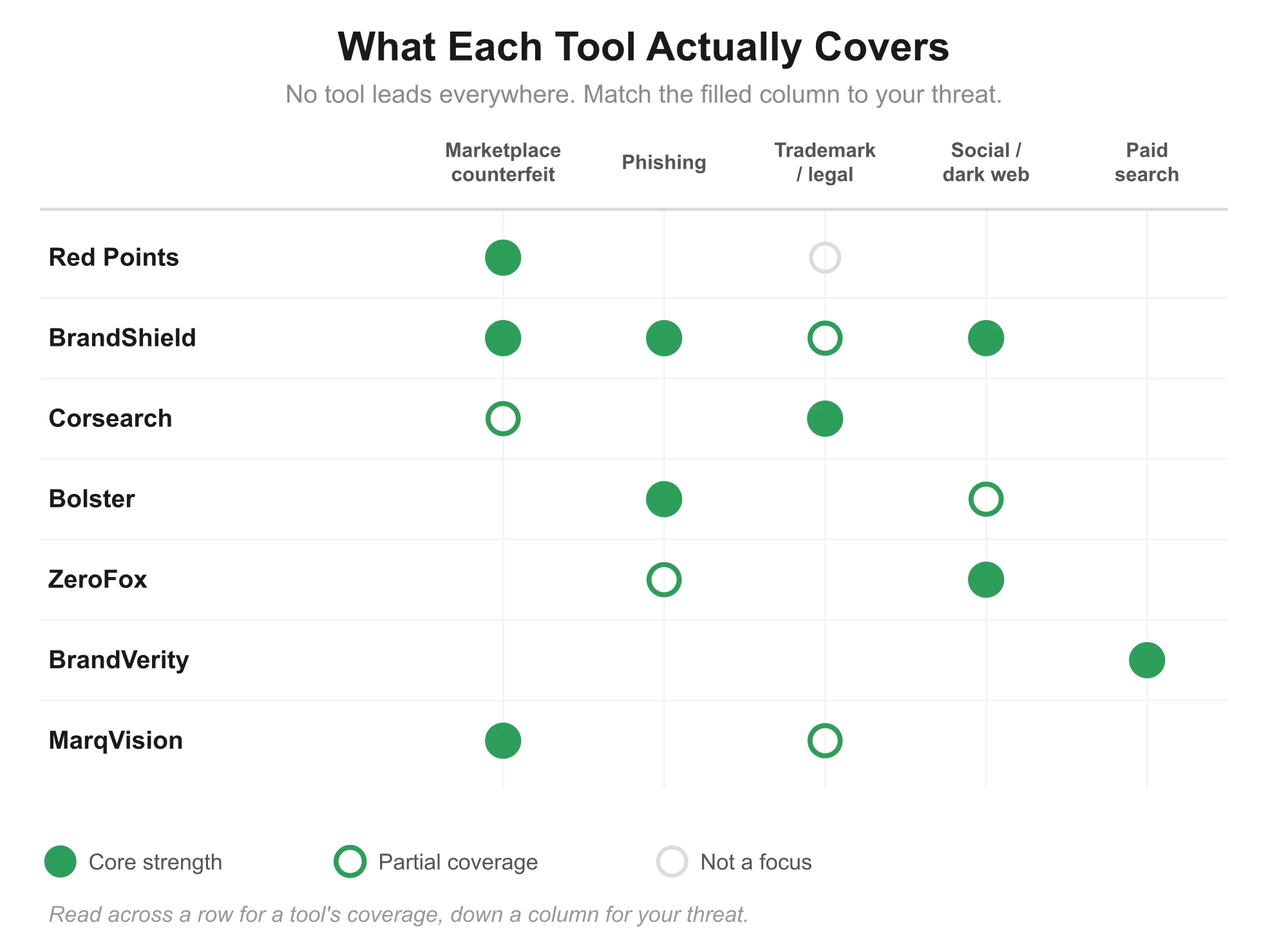
Your threat | The leader | Model |
|---|---|---|
Marketplace counterfeits | Red Points | Flat-fee, unlimited takedowns |
Broadest coverage | BrandShield | Quote, multi-channel |
Trademark and legal | Corsearch | Analyst-hour, offline action |
Phishing and impersonation | Bolster | Fast automated takedowns |
Digital risk and dark web | ZeroFox | Enterprise threat intelligence |
Paid-search brand bidding | BrandVerity | Paid-search compliance |
Asia marketplace counterfeits | MarqVision | AI, 1,500+ marketplaces |
Most vendors quote privately, so treat any figures as reported ranges and confirm directly.
 For Marketplace Counterfeits: 1. Red Points
If fake versions of your products are being sold on Amazon, eBay or other marketplaces, this is the category leader.
Red Points is AI-powered software focused on detecting and enforcing against counterfeits, piracy and impersonation at high volume, trusted by more than 1,300 brands.
Its defining feature is a flat-fee model with unlimited detections and takedowns, so your cost stays stable even during a seasonal spike in counterfeit activity, a real advantage over rivals that cap enforcement by analyst hours or credits.
Its strength is automated, high-volume marketplace enforcement with simplified workflows built for ecommerce operations.
The limitation is that it is less suited to broader digital threats like phishing or impersonation, and pricing is quote-only by protection type.
Best for: ecommerce brands fighting counterfeit listings at scale who want predictable enforcement costs.
For the Broadest Single-Platform Coverage: 2. BrandShield
If your brand is attacked across many channels at once and you want one platform to cover them, BrandShield spans the widest surface.
In business since 2014, BrandShield protects across websites, marketplaces, social media, ads, apps and the dark web, using AI to detect counterfeits, phishing, impersonation and lookalike domains.
Its AI.ClusterX feature uncovers connected networks of threat actors rather than isolated incidents, which matters when one bad actor runs many fakes.
It is often positioned as more affordable than the enterprise average depending on service mix, though enforcement is capped by plan and services are sold in packs, which limits flexibility. Pricing is quote-based.
Best for: brands facing threats across multiple channels who want unified coverage in a single platform.
For Trademark and Legal Enforcement: 3. Corsearch
If your protection is rights-driven, anchored in trademarks and legal enforcement, Corsearch is built around that discipline.
Founded all the way back in 1949, Corsearch offers full trademark lifecycle management, from registration through marketplace monitoring to offline investigations and physical raids overseas, plus anti-piracy for books, games and digital content.
That offline enforcement capability, taking real-world action against counterfeiters, sets it apart from the pure software platforms.
The trade-off is its model. Corsearch relies more heavily on analyst-led workflows, priced by analyst or intelligence hours and service package, which limits scalability during volume spikes compared with flat-fee rivals.
It suits mid-market to enterprise brands with legal teams.
Best for: enterprises and legal departments needing trademark-anchored, offline-capable enforcement.
For Phishing and Impersonation: 4. Bolster
If the threat is fake sites and impersonation rather than counterfeit products, a phishing specialist fits better than a marketplace tool.
Bolster detects and removes phishing sites, brand impersonation, fake online stores and fraudulent lookalike domains, with a reported average takedown time of around 12 hours, which is fast for this category.
Its focus is scams, phishing and impersonation.
The important limitation is that Bolster does not scan ecommerce sites, so it is not the tool for marketplace counterfeit enforcement. It is a specialist, and knowing that keeps you from buying it for the wrong job.
Best for: teams whose main threat is phishing, scams and impersonation rather than counterfeit products.
For Digital Risk and Dark Web: 5. ZeroFox
If your concern extends into executive impersonation, social threats and dark-web activity, this is a security-grade option.
ZeroFox is a digital risk protection platform monitoring social media, the surface web and the dark web for brand impersonation, phishing and broader cyber threats tied to your brand.
It brings threat-intelligence depth suited to security teams rather than marketers.
Its breadth and depth come with complexity and enterprise pricing, and it is aimed at organizations with a security function to run it. It fits alongside a broader threat stack rather than as a standalone marketing tool.
Best for: security-led enterprises needing wide digital-risk coverage including the dark web.
For Paid-Search Brand Bidding: 6. BrandVerity and 7. AdPolice
If competitors or affiliates are bidding on your brand keywords, you need paid-search protection, a distinct category the counterfeit tools do not touch.
BrandVerity is the established leader here, monitoring paid search across major engines for brand bidding, affiliate abuse and ad compliance, used by some of the world's largest brands.
AdPolice is its closest rival, with high-frequency scans and an uncloaking tool that exposes cloaked affiliate links, at a more accessible entry point.
I compared this niche in depth in this BrandVerity alternatives guide.
Both are the right tool only if paid search is your problem. Neither addresses counterfeits or phishing.
Best for: brands losing paid-search clicks and margin to competitors or non-compliant affiliates.
For Asia Marketplace Counterfeits: 8. MarqVision
If your counterfeit problem is concentrated on Asian marketplaces, a specialist there earns its place.
MarqVision, founded in 2020, is an AI-forward platform that removes fakes across more than 1,500 marketplaces with a particular focus on Asia, integrating AI more intuitively than some older rivals for strong usability.
It is a good choice for trademark services and marketplace counterfeit protection.
Its narrower point is that it covers fewer channels outside ecommerce than the broad platforms, so it is a marketplace specialist rather than an all-rounder.
Best for: brands whose counterfeit exposure is heaviest on Asian and global marketplaces.
How to Choose the Right Platform
The decision comes down to three questions, in order.
What is your actual abuse surface? This is the first and most important. Counterfeit listings point you to Red Points, MarqVision or BrandShield, and phishing or impersonation to Bolster or ZeroFox.
Paid-search abuse points to BrandVerity or AdPolice, compared in this guide to AdPolice alternatives.
Trademark enforcement points to Corsearch. Name the threat before you shortlist.
How do you want enforcement handled? Automated, high-volume takedowns favor Red Points and BrandShield. Analyst-led, offline-capable enforcement favors Corsearch. Match the enforcement style to your team's resources.
What does the pricing model do under pressure? Flat-fee tools like Red Points keep costs stable during infringement spikes, while analyst-hour or credit models can climb when you need them most.
For a brand with seasonal surges, that difference is significant.
Answer those three and the field narrows fast. The broad-coverage platforms are tempting, but a specialist matched to your real threat usually protects you better for less.
Frequently Asked Questions
What is the best brand protection software?
There is no single best. Red Points leads on marketplace counterfeits, BrandShield on breadth, Corsearch on trademark and legal, Bolster on phishing, and BrandVerity on paid search.
What is brand protection software?
Software that detects, prioritizes and removes unauthorized or fraudulent use of your brand online, from counterfeits and phishing to trademark infringement and ad abuse.
Which is best for ecommerce and counterfeits?
Red Points, for high-volume automated marketplace takedowns with a predictable flat-fee model, or MarqVision for Asia-focused marketplace protection.
Which is best for phishing and impersonation?
Bolster for fast phishing and impersonation takedowns, or ZeroFox for broader digital-risk coverage including the dark web.
Which is best for paid-search brand bidding?
BrandVerity is the established leader, with AdPolice its closest rival at a more accessible entry price. Both focus on paid search, not counterfeits.
How much does brand protection software cost?
Most platforms quote privately by scope. Models vary from Red Points' flat fee to Corsearch's analyst-hour pricing, so cost depends heavily on your protection type and volume.
Which industries need brand protection software?
Ecommerce, fashion, luxury, pharma, software, finance and any brand with valuable IP, a marketplace presence, or heavy paid-search spend.
How do I choose the right one?
Start with your actual threat, then your preferred enforcement style, then how the pricing behaves under volume spikes. The threat you face should drive the choice.
The Bottom Line
The best brand protection software is the one built for the threat you actually face, not the one at the top of a generic ranking. Match the tool to your abuse surface and the choice becomes clear.
For marketplace counterfeits, Red Points and MarqVision lead, with BrandShield for the broadest coverage. For phishing and impersonation, Bolster and ZeroFox.
For trademark and legal enforcement, Corsearch. And for paid-search brand bidding, BrandVerity and AdPolice.
Name your threat, weigh how enforcement and pricing behave under real pressure, and shortlist the two or three built for your channel. That focused match, not a universal winner, is what actually protects your brand.