
Your brand is one of your most valuable assets, and online, it is under constant, low-level attack.
Counterfeiters copy your products, competitors bid on your name in ads, scammers build fake versions of your site, and affiliates break the rules they agreed to.
Brand protection software is what watches for all of that and helps you shut it down.
In plain terms, brand protection software is a tool that automatically finds unauthorized or fraudulent use of your brand across the internet and helps you remove it.
It is the difference between discovering a problem months later by accident and catching it within minutes, with the evidence to act.
This guide explains what the software actually is, the threats it defends against, how it works under the hood, the features that matter, and how to choose one. No jargon, just a clear picture of a category that has quietly become essential.
What Is Brand Protection Software, Exactly?
Start with the simplest possible definition, then build on it.
Brand protection software is a platform that continuously monitors digital channels, search engines, marketplaces, websites, social media and ad networks, for misuse of your brand, then alerts you and helps you take it down.
Think of it as an always-on security system for your brand's presence online.
A human could, in theory, do some of this by hand: searching for your brand name, checking marketplaces for fakes, watching for copycat ads. But the internet is far too big and moves far too fast for that to work at any scale.
The software automates the watching, so nothing slips through while you sleep.
That automation is the whole point. It turns brand protection from an occasional, reactive scramble into a continuous, systematic defense.
Why Businesses Need It
Brand abuse is not a rare event, it is a constant background hum that grows with your visibility. The more successful your brand, the more attractive a target it becomes.
The cost is real and measurable, with counterfeiting alone accounting for a large and growing share of global trade, as bodies like the OECD track illicit trade.
Counterfeit sales steal revenue directly and can poison your reputation when a customer buys a fake and blames you for its poor quality.
Competitors bidding on your brand keywords inflate your advertising costs and siphon off customers who were searching for you specifically.
Phishing sites and fake stores that impersonate you can defraud your customers and destroy the trust you spent years building.
And affiliates who break their agreements, bidding on your brand or making false claims, quietly erode your margins and your compliance standing.
Left unchecked, these threats compound.
Brand protection software exists because, past a certain size, ignoring them is far more expensive than defending against them, and the best brand protection software tools now cover each of these threats in different ways.
The Common Online Brand Threats
To understand what the software does, it helps to know exactly what it is defending against. The threats fall into a handful of clear categories.
Counterfeit products. Fake versions of your goods sold on marketplaces like Amazon and eBay, stealing sales and damaging your reputation with poor quality.
Trademark infringement. Others using your brand name, logo or protected marks without permission, in listings, domains or content.
Paid-search brand bidding. Competitors or affiliates bidding on your brand keywords in Google or Bing ads to intercept people searching for you.
Phishing and impersonation. Fake websites, fake stores and social accounts posing as your brand to defraud your customers or steal their data.
Affiliate non-compliance. Your own affiliate partners breaking their agreements, through unauthorized brand bidding, ad hijacking or coupon abuse.
Domain abuse. Lookalike or typosquatted domains that trade on your name to mislead visitors or host scams.
Each of these is a distinct problem, and the strongest brand protection platforms address several at once, which is why the category spans so many features.
How Brand Protection Software Works
Under the hood, almost every platform follows the same three-step cycle: detect, analyze, enforce. Understanding it demystifies the whole category.
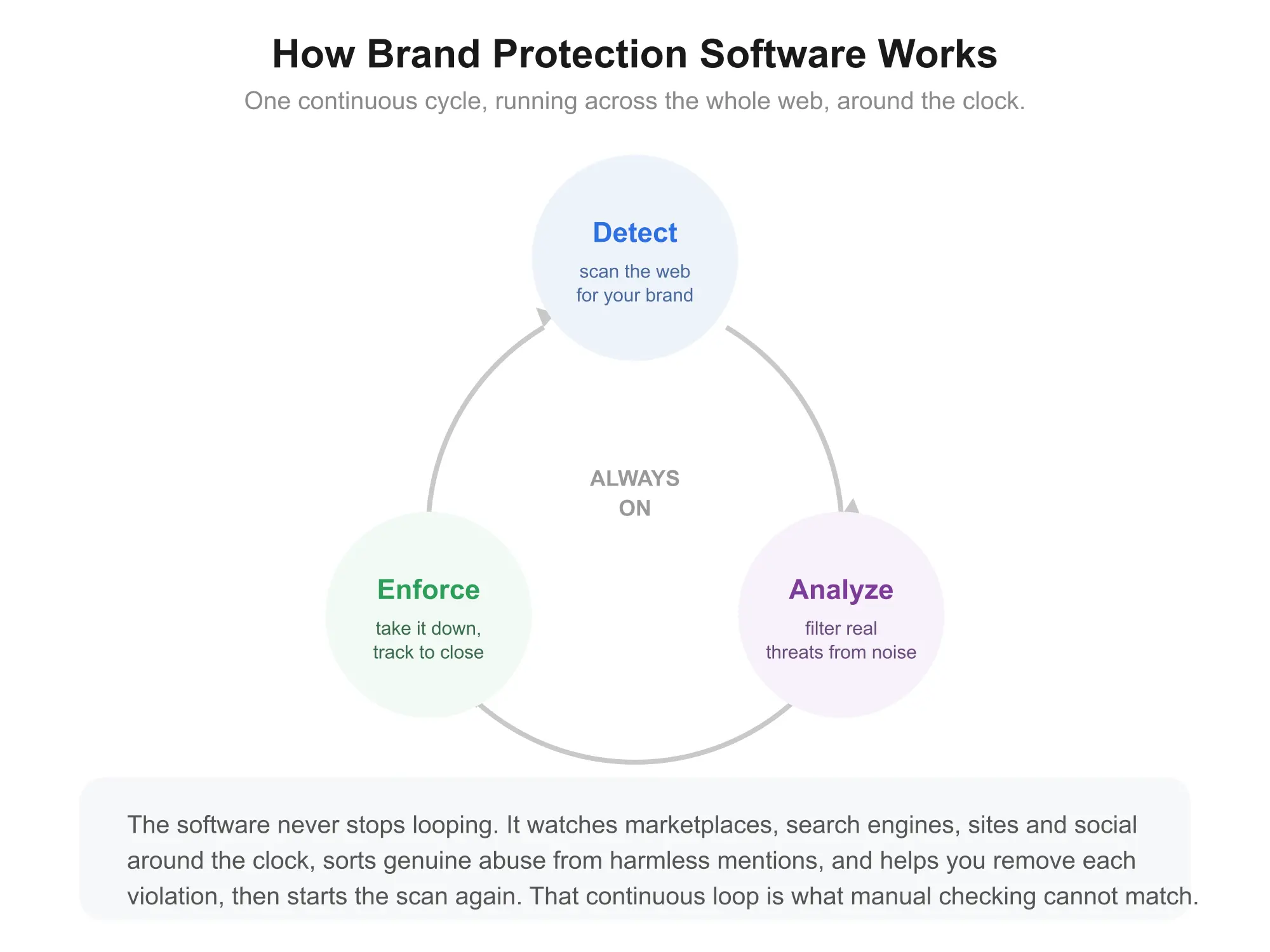
Detection comes first. The software continuously scans the channels where abuse happens, search engines, marketplaces, websites, social platforms and ad networks, looking for your brand name, logos, products and keywords.
It casts a wide net across regions and languages, far wider than any manual check.
Analysis comes next. Raw detections include plenty of legitimate mentions, so the software uses rules and increasingly AI to separate genuine threats from noise, prioritizing what actually needs action.
Good platforms score and cluster violations so you see the real problems, not a flood of false alarms.
Enforcement closes the loop. Once a genuine violation is confirmed, the software helps you act, generating takedown requests, sending violation notices, submitting reports to marketplaces or search engines, and tracking each case to resolution.
The best tools automate much of this, turning detection into removal with minimal manual work.
That detect-analyze-enforce cycle, running continuously across the whole web, is the essence of what you are buying.
Core Features to Look For
Not every platform does everything, and the features you need depend on your threats. These are the building blocks to weigh.
Continuous monitoring across the channels that matter to you, search, marketplaces, social, domains, with the geographic and language coverage your brand requires.
Detection accuracy, powered by AI and image recognition, to catch real abuse including altered logos and cloaked pages while minimizing false positives.
Automated enforcement, the ability to generate and submit takedowns and violation notices at scale, not just flag problems for you to chase manually.
Reporting and analytics, clear dashboards and evidence trails that show what was found, what was actioned, and the return on your investment.
Alerts and integrations, real-time notifications through email, Slack or other tools, plus an API to fit the platform into your existing workflow.
The right mix depends on your situation. A marketplace-heavy brand weights detection and takedown volume; a paid-search-heavy brand weights ad monitoring and evidence capture.
The Main Types of Brand Protection
The category is broad, so it helps to see the main specialties. Most tools lead in one or two of these areas.
Trademark monitoring watches for unauthorized use of your registered marks across listings, domains and content, and is the foundation of rights-based enforcement.
Counterfeit and marketplace monitoring hunts fake products across online marketplaces and automates their removal, the priority for physical-goods and ecommerce brands.
Affiliate compliance monitoring watches your affiliate partners for rule-breaking like unauthorized brand bidding or ad hijacking, protecting your margins and your program's integrity.
Paid-search and PPC monitoring tracks who is bidding on your brand keywords across search engines, catching both competitors and non-compliant affiliates intercepting your traffic.
AdPolice is one accessible tool in this space, covered in this AdPolice review.
Digital risk and phishing protection covers fake sites, impersonation and dark-web threats, the security-minded end of the category.
Because these specialties rarely all live in one tool, choosing well means matching the specialty to your actual problem.
Benefits for Ecommerce and Enterprise
The payoff differs by business type, and both cases are compelling.
For ecommerce brands, the software protects revenue and reputation directly. Removing counterfeit listings recovers lost sales, stops customers from buying fakes that damage your name, and keeps your marketplace presence clean.
For a brand living on Amazon or its own store, that is a direct line to the bottom line.
For enterprise businesses, the value is broader: protecting a large IP portfolio, maintaining compliance across markets and regulations, defending brand reputation at scale, and giving legal and marketing teams the evidence they need to act.
At enterprise size, the risk of unmanaged brand abuse is simply too large to leave to chance.
In both cases, the underlying benefit is the same. Brand protection software converts a sprawling, invisible risk into a managed, measurable process.
How to Choose the Right Solution
With the concept clear, choosing comes down to matching a tool to your reality. A few questions settle most of the decision.
What is your biggest threat? Counterfeits point you toward marketplace-focused tools, paid-search abuse toward ad-monitoring specialists, phishing toward digital-risk platforms. Name the threat first, because no tool leads at all of them.
What is your scale and budget? Options range from accessible tools starting around a couple of hundred dollars a month, like those in this AdPolice pricing breakdown, to six-figure enterprise suites.
Buy for the problem you have, not the one you imagine.
How do you want enforcement handled? Some tools automate high-volume takedowns; others rely on analyst-led investigations. Match the style to your team's resources.
If you are weighing the established paid-search leader against cheaper options, the BrandVerity alternatives comparison maps the nearest tools by price and scope.
Frequently Asked Questions
What is brand protection software?
A tool that automatically monitors the internet for unauthorized or fraudulent use of your brand, counterfeits, impersonation, trademark abuse and ad misuse, then helps you remove it.
How does brand protection software work?
It follows a detect-analyze-enforce cycle: continuously scanning digital channels for abuse, filtering real threats from noise, then helping you issue takedowns and track them to resolution.
Why is brand protection software important?
Because online brand abuse steals revenue, inflates ad costs and erodes trust. Past a certain size, defending against it costs far less than ignoring it.
Who needs brand protection software?
Any brand with valuable IP, a marketplace presence, an affiliate program or significant paid-search spend, especially in ecommerce, fashion, luxury, pharma and software.
What features should it include?
Continuous monitoring, accurate AI-driven detection, automated enforcement and takedowns, clear reporting, and real-time alerts with integrations into your workflow.
What is trademark monitoring software?
A type of brand protection tool that watches for unauthorized use of your registered trademarks across listings, domains and content, forming the basis of rights-based enforcement.
What is affiliate compliance monitoring?
Software that watches your affiliate partners for rule-breaking such as unauthorized brand bidding, ad hijacking or coupon abuse, protecting your margins and program integrity.
How can software detect counterfeit products?
By continuously scanning marketplaces with AI and image recognition to spot fake listings of your products, then automating their reporting and removal.
What is the best brand protection software?
There is no single best. The right tool depends on your main threat, whether counterfeits, paid search, phishing or trademark abuse, since each tool leads in a different area.
How do I choose the right one?
Start with your biggest threat, then weigh your scale and budget and your preferred enforcement style. The threat you face should drive the choice.
The Bottom Line
Brand protection software is, at its core, an automated defense system for your brand's presence online.
It continuously watches the marketplaces, search engines, websites and social platforms where your brand can be abused, filters the real threats from the noise, and helps you remove them fast.
Businesses need it because online brand abuse is constant, costly and invisible without the right tools, and it only grows as your brand does.
The software turns that sprawling risk into a managed process, protecting revenue, reputation and customer trust.
The right choice always starts with the same question: what threat are you actually facing? Answer that, match a tool to it, and brand protection stops being a worry and becomes a system working quietly in the background.